Words
Words Americans Pronounce Differently: 32 Everyday Words, US vs UK, by Pattern
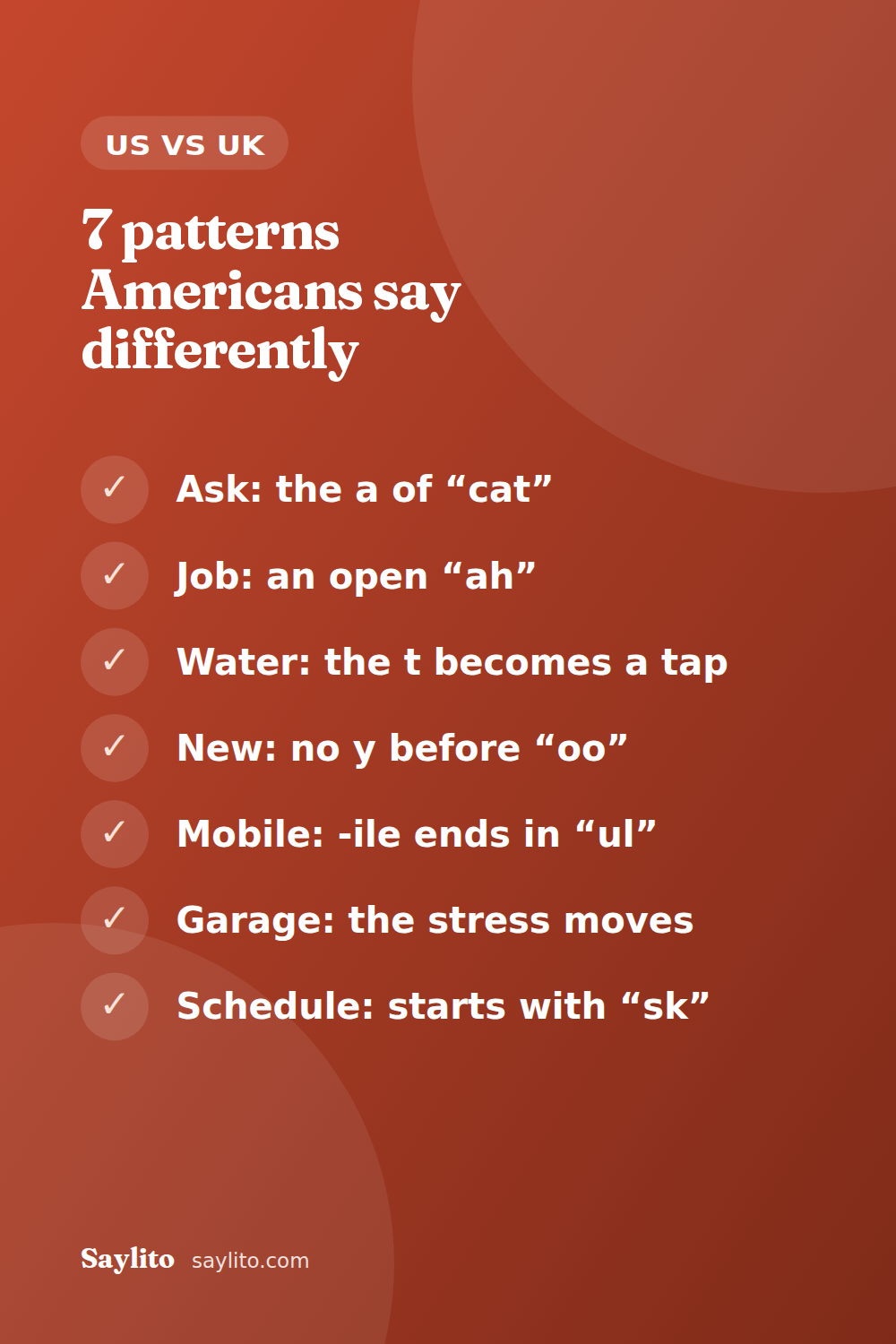
Most of the words Americans pronounce differently from British speakers follow a handful of patterns, not a random list. The a in ask and after becomes the a of cat. The o in job and project opens to “ah”. A t between vowels, as in water and meeting, turns into a quick tap. New, student and duty lose their small y sound. Words ending in -ile, like mobile, end in a short “ul”. A few long words move their stress. Then there are some true one-offs: schedule, route, herb, privacy, leisure, tomato and the letter Z.
Below are 32 everyday words sorted by pattern, with the British and American pronunciations side by side in IPA. Learn a pattern once and you'll recognize it in words you've never looked up.
Words Americans pronounce differently: the short answer
- ask, after, answer: the a of “cat”, /æ/, where British English has a long “ah”.
- job, project, process: an open “ah”, /ɑː/, where British English has a short rounded o, or an “oh” in process and progress.
- water, meeting, city: a t between two vowels becomes a quick tap, close to a light d.
- new, student, duty: no y sound before the “oo”.
- mobile, fragile, hostile: -ile ends in a short “ul”, not like “aisle”.
- advertisement, garage, laboratory: the stress lands on a different syllable.
- one-offs: schedule with a k, herb with no h, privacy with a long i, Z said “zee”.
One more thing runs through almost every word below: an r written after a vowel is said in American English. After, answer and water all end in a real r sound, written /ɚ/, where British English ends in a plain “uh”.
Do you need to switch to the American forms?
No. Both sets are correct English, and good dictionaries list them side by side. The goal worth having is being understood easily, not sounding like someone else, and you can be clear with either set.
There are still two good reasons to know the American forms. First, they're what you'll hear in US meetings, calls, videos and podcasts, and a word you recognize instantly is one less thing to decode while someone's talking. Second, if you've already picked American English as the version you're aiming for, these patterns are some of the quickest wins, because each one covers a whole family of words.
If you end up mixing the two, that's fine. Pick the words you say most and start there.
The a in ask, after and answer
In British English, a group of words with an a before s, f or n is said with a long “ah”, /ɑː/. American English uses the short a of “cat”, /æ/, in the same words. It's one pattern, and it covers a lot of everyday speech.
| Word | UK | US |
|---|---|---|
| ask | /ɑːsk/ | /æsk/ |
| after | /ˈɑːf.tə/ | /ˈæf.tɚ/ |
| answer | /ˈɑːn.sə/ | /ˈæn.sɚ/ |
| task | /tɑːsk/ | /tæsk/ |
| class | /klɑːs/ | /klæs/ |
To make /æ/, open your jaw wide, keep your tongue low and push it a little forward, as in “cat” or “have”. It's close to the e of “bed”, only lower, with your mouth more open. Then train your ear on pairs that differ only in that vowel, like “cat” and “cut” or “cap” and “cop”, and say each one right after you hear it.
The o in job, project and process
Where British English has a short, rounded o, /ɒ/, in words like job and contract, American English has an open “ah”, /ɑː/, with relaxed lips. So job sounds close to “jahb”. Two nouns go a step further: process and progress start with “oh” in British English, and with the same open “ah” in American English.
| Word | UK | US |
|---|---|---|
| job | /dʒɒb/ | /dʒɑːb/ |
| project (noun) | /ˈprɒdʒ.ekt/ | /ˈprɑː.dʒekt/ |
| process (noun) | /ˈprəʊ.ses/ | /ˈprɑː.ses/ |
| progress (noun) | /ˈprəʊ.ɡres/ | /ˈprɑː.ɡres/ |
| contract (noun) | /ˈkɒn.trækt/ | /ˈkɑːn.trækt/ |
Watch the verbs, though. To project, to progress and to contract put the stress on the second syllable, /prəˈdʒekt/, /prəˈɡres/ and /kənˈtrækt/, and those sound the same on both sides of the Atlantic. “Our project is in progress” uses the open “ah” twice. “Sales should progress” doesn't use it at all.
The t in water, meeting and city
This is one of the best-known American sounds. When a t sits between two vowel sounds and the syllable after it isn't stressed, American speakers make it a quick tap of the tongue tip, close to a light d. In IPA it's written /t̬/. British English keeps a full t.
| Word | UK | US |
|---|---|---|
| water | /ˈwɔː.tə/ | /ˈwɑː.t̬ɚ/ |
| better | /ˈbet.ə/ | /ˈbet̬.ɚ/ |
| meeting | /ˈmiː.tɪŋ/ | /ˈmiː.t̬ɪŋ/ |
| city | /ˈsɪt.i/ | /ˈsɪt̬.i/ |
| data | /ˈdeɪ.tə/ | /ˈdeɪ.t̬ə/ or /ˈdæt̬.ə/ |
Water changes three things at once: the vowel opens toward “ah”, the t becomes a tap, and the end gets its r. Data has two American forms, “DAY-tuh” and “DAT-uh”, and the dictionary lists both.
The tap only happens before an unstressed syllable. In attack, /əˈtæk/, and hotel, /hoʊˈtel/, the stress falls right after the t, so it stays a full, crisp t in American English too. That's a handy check when you're not sure: find the stress first.
New, news, student and duty: no y sound
British English puts a small y sound before the “oo” in words like new and student: new is “nyoo”, /njuː/. American English drops it after n, t and d. New is “noo”, student is “STOO-dent”, and duty is “DOO-tee”, with a tapped t.
| Word | UK | US |
|---|---|---|
| new | /njuː/ | /nuː/ |
| news | /njuːz/ | /nuːz/ |
| student | /ˈstjuː.d(ə)nt/ | /ˈstuː.d(ə)nt/ |
| duty | /ˈdjuː.ti/ | /ˈduː.t̬i/ |
Don't drop it everywhere. Few, /fjuː/, and music, /ˈmjuː.zɪk/, keep their y sound in American English too. The change happens after the tongue-tip sounds n, t and d, not after f or m.
Mobile, fragile, hostile: the -ile ending
In British English these words end like “aisle”, /aɪl/. In American English the ending shrinks to a short “ul”. The vowel before the l is so short that it's shown as optional, which is why it's in brackets below.
| Word | UK | US |
|---|---|---|
| mobile | /ˈməʊ.baɪl/ | /ˈmoʊ.b(ə)l/ |
| fragile | /ˈfrædʒ.aɪl/ | /ˈfrædʒ.(ə)l/ |
| hostile | /ˈhɒs.taɪl/ | /ˈhɑː.st(ə)l/ |
So a “mobile app” in an American meeting sounds like “MOH-bul app”. Not every -ile word changes, though. While, smile and file end like “aisle” in both, /waɪl/, /smaɪl/ and /faɪl/. So learn the short ending word by word, starting with the three above.
Advertisement, garage, laboratory: the stress moves
A few long words put their stress on a different syllable. American advertisement stresses “tise”, with a long i: ad-ver-TISE-ment. British advertisement stresses “ver”. American garage stresses its second syllable, “guh-RAHZH”. American laboratory stresses the first syllable and folds the middle: “LAB-ruh-tor-ee”.
| Word | UK | US |
|---|---|---|
| advertisement | /ədˈvɜː.tɪs.mənt/ | /ˌæd.vɚˈtaɪz.mənt/ |
| garage | /ˈɡær.ɑːʒ/ | /ɡəˈrɑːʒ/ |
| laboratory | /ləˈbɒr.ə.t(ə)r.i/ | /ˈlæb.rə.tɔːr.i/ |
Stress carries a lot of weight in English. It's the beat a listener follows, and a word with its stress in an unexpected place can take a listener a moment longer to recognize. So if you change one thing in these three words, move the stress first and let the vowels follow.
Seven one-off words: schedule, route, herb and more
These don't belong to a family. Each one simply has its own American form, and you learn them one by one.
| Word | UK | US |
|---|---|---|
| schedule | /ˈʃedʒ.uːl/ | /ˈskedʒ.uːl/ |
| route | /ruːt/ | /ruːt/ or /raʊt/ |
| herb | /hɜːb/ | /ɝːb/ |
| privacy | /ˈprɪv.ə.si/ | /ˈpraɪ.və.si/ |
| leisure | /ˈleʒ.ə/ | /ˈliː.ʒɚ/ |
| tomato | /təˈmɑː.təʊ/ | /təˈmeɪ.t̬oʊ/ |
| Z (the letter) | /zed/ | /ziː/ |
- Schedule starts with “sk”, like school: “SKEJ-ool”.
- Route has two American forms, “root” and “rowt” (rhymes with out). Both are fine.
- Herb has no h in American English: “erb”, with the r said.
- Privacy has the long i of “private”: “PRY-vuh-see”.
- Leisure starts with the “ee” of see: “LEE-zher”.
- Tomato has the a of day and a tapped t: “tuh-MAY-toh”.
- Z is “zee”, which rhymes with see.
That last one is worth learning even if you change nothing else. When you spell out a name, an email address or a reference code on a call, there's no sentence around a single letter to help the listener guess. “Zee” is the letter an American listener expects to hear.
A ten-minute drill for the words you say at work
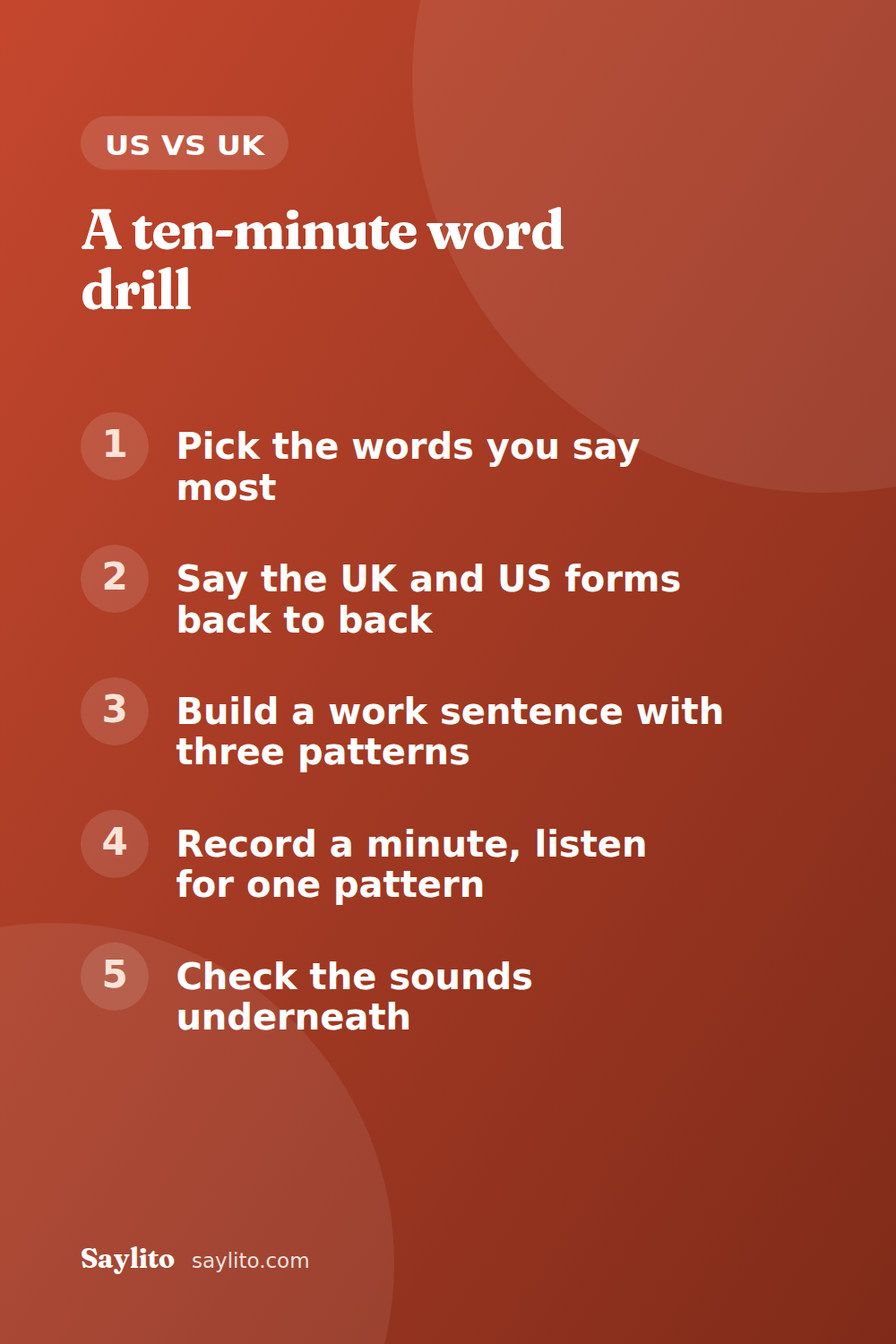
You don't need to learn all 32 at once. Start with the words you actually say, and practise them inside real sentences:
- Pick your words. Look at a normal week: the meetings, calls and emails you read out. Circle the words from the tables above that you say most.
- Say the pair. Say the British form, then the American form, slowly, so you feel what changes: the vowel, the t, the stress.
- Build a work sentence. “Can you send me the schedule after the meeting?” covers three patterns in one line. “The new data looks better” covers two more.
- Record one minute. Read your sentences aloud, play them back, and listen for the patterns one at a time: first the a of cat, then the tapped t, then the stress.
- Check the sounds underneath. Saylito's free accent test listens to a few sentences and shows which sounds to practise first.
Ten minutes, three or four days a week, is plenty. Once a pattern feels normal in five words, you'll start hearing it in new ones on your own, and that's when the American forms stop sounding foreign and start sounding like English you know.
Questions people ask
What words do Americans pronounce differently to the English?
Mostly words that follow a few patterns: the a in ask, after and answer (said as in cat), the o in job and project (an open ah), a t between vowels in water and meeting (a quick tap), no y sound in new and student, -ile words like mobile, a few stress shifts like advertisement and garage, and one-offs like schedule, herb, privacy, tomato and the letter Z.
What are 19 words that British and Americans say differently?
Nineteen words British and American speakers say differently: ask, after, answer, job, project, water, city, new, student, mobile, garage, advertisement, schedule, route, herb, privacy, leisure, tomato and the letter Z. Most of them follow a few patterns, so the pattern behind each one carries over to words beyond these nineteen.
Why do Americans say Zee not Zed?
American English calls the letter zee and British English calls it zed, and each is standard in its own country. The practical point is simple: when you spell something out to an American listener, zee is the name they expect.
Sources
- Cambridge Dictionary, Phonetics: the IPA symbols used for UK and US English, including /æ/, /ɑː/, /ɚ/, /ɝː/ and the US tapped /t̬/
- Cambridge Dictionary, UK and US pronunciation of “ask”
- Cambridge Dictionary, UK and US pronunciation of “after”
- Cambridge Dictionary, UK and US pronunciation of “answer”
- Cambridge Dictionary, UK and US pronunciation of “task”
- Cambridge Dictionary, UK and US pronunciation of “class”
- Cambridge Dictionary, UK and US pronunciation of “job”
- Cambridge Dictionary, UK and US pronunciation of “project”
- Cambridge Dictionary, UK and US pronunciation of “process”
- Cambridge Dictionary, UK and US pronunciation of “progress”
- Cambridge Dictionary, UK and US pronunciation of “contract”
- Cambridge Dictionary, UK and US pronunciation of “water”
- Cambridge Dictionary, UK and US pronunciation of “better”
- Cambridge Dictionary, UK and US pronunciation of “meeting”
- Cambridge Dictionary, UK and US pronunciation of “city”
- Cambridge Dictionary, UK and US pronunciation of “data”
- Cambridge Dictionary, UK and US pronunciation of “attack”
- Cambridge Dictionary, UK and US pronunciation of “hotel”
- Cambridge Dictionary, UK and US pronunciation of “new”
- Cambridge Dictionary, UK and US pronunciation of “news”
- Cambridge Dictionary, UK and US pronunciation of “student”
- Cambridge Dictionary, UK and US pronunciation of “duty”
- Cambridge Dictionary, UK and US pronunciation of “few”
- Cambridge Dictionary, UK and US pronunciation of “music”
- Cambridge Dictionary, UK and US pronunciation of “mobile”
- Cambridge Dictionary, UK and US pronunciation of “fragile”
- Cambridge Dictionary, UK and US pronunciation of “hostile”
- Cambridge Dictionary, UK and US pronunciation of “while”, “smile” and “file”
- Cambridge Dictionary, UK and US pronunciation of “advertisement”
- Cambridge Dictionary, UK and US pronunciation of “garage”
- Cambridge Dictionary, UK and US pronunciation of “laboratory”
- Cambridge Dictionary, UK and US pronunciation of “schedule”
- Cambridge Dictionary, UK and US pronunciation of “route”
- Cambridge Dictionary, UK and US pronunciation of “herb”
- Cambridge Dictionary, UK and US pronunciation of “privacy”
- Cambridge Dictionary, UK and US pronunciation of “leisure”
- Cambridge Dictionary, UK and US pronunciation of “tomato”
- Cambridge Dictionary, UK and US pronunciation of the letter “z”
Keep reading
General American Accent: The Features That Help You Be Understood
The General American accent, explained for learners: what it is, which of its sounds help listeners understand you, and which ones you can safely skip.
Hard Words to Pronounce in English: 27 Everyday Words and Why They Trip You Up
Hard words to pronounce in English that you actually use: 27 everyday words in five groups, why each one is hard, and how Americans say it, in IPA.
How to Pronounce Through, Though, Thought, Tough and Thorough in American English
How to pronounce through, though and thought in American English, plus tough and thorough: five -ough words, five sounds, and the slips listeners hear.