Sounds
How to Pronounce Through, Though, Thought, Tough and Thorough in American English

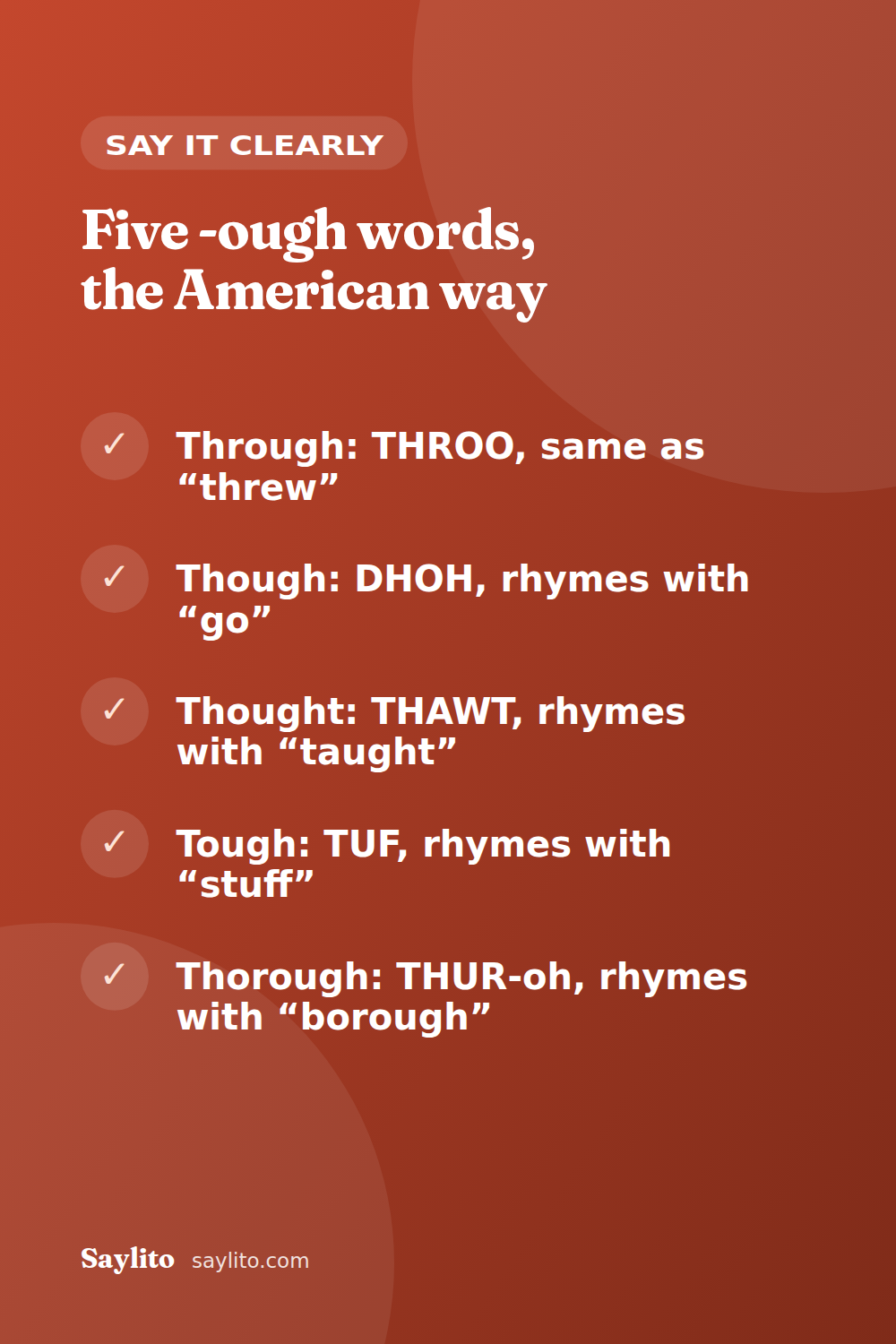
Here's how to pronounce them in American English. Through is THROO, /θruː/, and sounds exactly like “threw”. Though is DHOH, /ðoʊ/, and rhymes with “go”. Thought is THAWT and rhymes with “taught”. Tough is TUF, /tʌf/, and rhymes with “stuff”. Thorough is THUR-oh, two syllables, and rhymes with “borough”. The spelling -ough doesn't tell you which one you're looking at, so don't read it. Look at the first sound and the vowel instead.
That's the short version. Below, the five words come apart one sound at a time, with the slips a listener actually notices and a two-minute drill at the end.
The short answer: five words, five different sounds
| Word | IPA (US) | Say it |
|---|---|---|
| through | /θruː/ | THROO |
| though | /ðoʊ/ | DHOH |
| thought | /θɑːt/ | THAWT |
| tough | /tʌf/ | TUF |
| thorough | /ˈθɝː.oʊ/ | THUR-oh |
In the “say it” column, capitals mark the stressed syllable, “th” is the quiet th of “think” and “dh” is the buzzing th of “this”. Four of the five are one syllable. Thorough is the only one with two.
Why the -ough spelling won't help you
In these five words, the letters -ough stand for an oo in through, an oh in though, an aw in thought and an uff in tough. In thorough they're an oh again, after a first syllable that sounds like “her”. The gh is silent in four of the words and sounds like an f in one. No rule predicts that: English spelling settled long ago, and the way people said the words kept changing.
So reading the word letter by letter is the slow road. The fast road is to learn each one as a sound, the way you'd learn a name. And it helps to notice that there are really only two decisions to make in each word: how it starts and which vowel comes next. Get those two right and the listener hears the word you meant, even with an accent.
Quiet th, buzzing th, or no th at all
Start with the first sound, because it's where most of the trouble lives.
- Through, thought and thorough start with the quiet th, /θ/: the th of “think”. Rest the tip of your tongue lightly between your teeth and blow air over it, with no voice. A hand on your throat feels nothing.
- Though is the only one that starts with the buzzing th, /ð/: the th of “this” and “the”. Same tongue position, voice switched on. Your throat buzzes.
- Tough has no th at all. It starts with a plain t, like “top”. The spelling puts a t and an o next to each other, nothing else.
Here's the part that helps learners most. When the quiet th slips, it usually turns into a t, an s or an f, and in these words every one of them lands on a different real word. Say “thought” with a t and you've said “taught”. With an s, it's “sought”. With an f, it's “fought”. All four share the same vowel and the same t at the end: the only difference is that first sound. You can train it with pairs like think and sink, three and tree in the th sound drill.
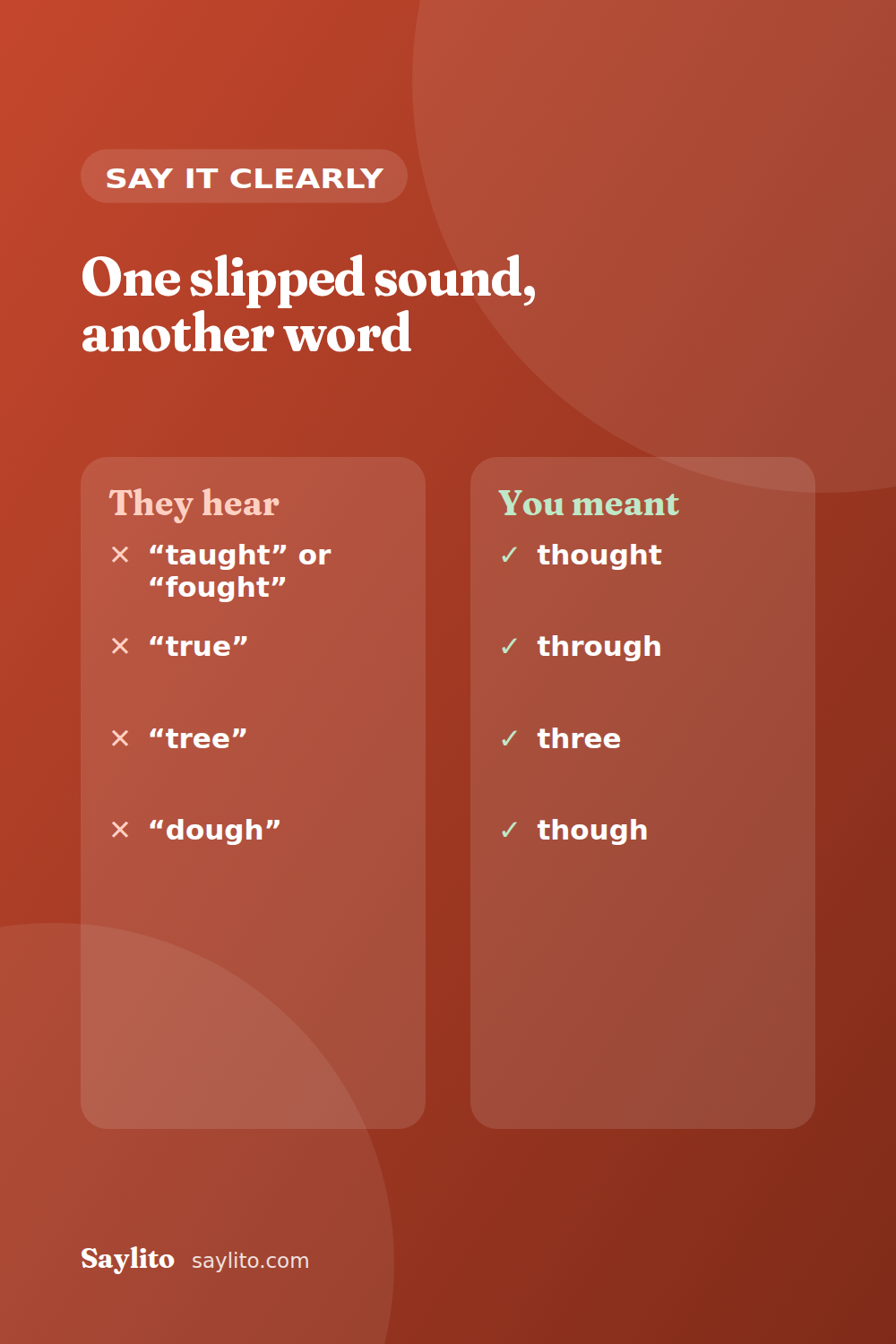
In a sentence, context usually makes the meaning clear. Nobody thinks “I taught so” means anything but “I thought so”. But it costs the listener a split second each time, and in a fast meeting or on a bad phone line those split seconds add up. That's the real reason to practise the th: not to sound “perfect”, just to be easy to follow.
What is the correct pronunciation of through?
Through is /θruː/: the quiet th, an r, and the long oo of “food”. One syllable. It sounds exactly like “threw”, the past of throw: in IPA the two words are the same, /θruː/.
The hard part is the th and the r back to back. Your tongue has to start between your teeth and then pull back and curl for the r, with no vowel in between. Two things tend to happen when that move feels awkward: the th turns into a t and you get “true”, or a tiny vowel sneaks in and you get something like “thuh-roo”. Aim for “threw”, never “true”, and check yourself against the model voice on the through page.
Practise the move slowly: hold the th for a moment, air only, then slide straight into the r. Thhh-roo. Then shorten the th until it's quick. “Three”, “throw” and “thread” use the same start, so you can drill them together. And throughout is just through plus “out”, with the stress on the second part: throo-OUT, /θruːˈaʊt/.
What is the correct pronunciation of though?
Though is /ðoʊ/: the buzzing th and the oh of “go”. One syllable, and the gh is silent. It rhymes with “go”, “so” and “dough”. Think of it as “dough” with a buzzing th in place of the d.
That d is exactly the slip to watch for. The buzzing th usually slips to a d or a z, and with a d, though becomes “dough”. If the buzzing th is new to you, start with this, these and those, three everyday words that all begin with it, then practise pairs like they and day in the voiced th drill.
The vowel matters too. In American English the oh of though is a glide, not one still sound: it starts at o and slides toward the oo of “put”, which is why the IPA has two symbols, /oʊ/. A short, flat o with no slide makes the word sound clipped. And because it's the only buzzing one of the five, check that it really buzzes: hand on your throat, and you should feel it from the very start of the word.
Through vs though, the question a lot of people ask: they differ in all three places. Through starts with the quiet th, has an r, and ends in oo. Though starts with the buzzing th, has no r, and ends in oh. They also mean different things. Through is about going from one side to the other (“walk through the park”). Though works like “but” or “however” (“It was cold, though”).
Thought: one word, two American vowels
Thought starts with the quiet th and ends in a clear t. The vowel in the middle is where Americans split. Many say it with the vowel of “saw”, /θɔt/, the THAWT you can practise on the thought page. Many others use the vowel of “father” and “hot”, /θɑːt/.
Both are American. Look at “caught” and “cot”: said with the same vowel, both are /kɑːt/; said the other way, “caught” takes the saw vowel. That's a real split among American speakers. For many of them those two vowels have merged into one, and for others they're still different.
What does that mean for you? Pick either and you'll be understood. Either way, the rhyme stays the same: thought sounds like taught with a th at the start, so if you can say “taught”, you already have the vowel and the ending. What does stand out is the gh. It's silent here. “Thought” never has a g or a k sound in it, and it never has an f.
The ending deserves one more line. Hold the final t lightly but say it, and don't add a vowel after it. A small “uh” after the t (“thought-uh”) is an easy slip when your first language rarely ends a word on a consonant. Stop on the t.
Tough and thorough: the odd one out and the long one
Tough is /tʌf/: a plain t, the short u of “cup”, and an f. Here the gh does make a sound, an f, just like in “enough” and “rough”. It rhymes with “stuff” and “puff”. The only trap is the spelling: there's no th in tough, so the tongue stays behind your teeth.
Thorough is the one with two syllables, stressed on the first: THUR-oh. In American English it ends either in a full oh, /ˈθɝː.oʊ/ (THUR-oh), or in a weak uh, /ˈθɝː.ə/ (THUR-uh), and some speakers say THAW-roh. The first syllable has the r-colored vowel of “her” and “bird”, and in the THUR-oh form the second is the same oh you hear in though.
The easiest anchor is “borough”: in American English the two rhyme. The usual slip is to squeeze thorough into one syllable and get something close to “through”. Count it on two fingers as you say it: THUR, oh. Hear it at two speeds on the thorough page before you try it yourself.
A two-minute drill for all five words
Use your phone's voice recorder. Listening back is where most of the learning happens, because it's hard to hear your own vowels while you're making them.
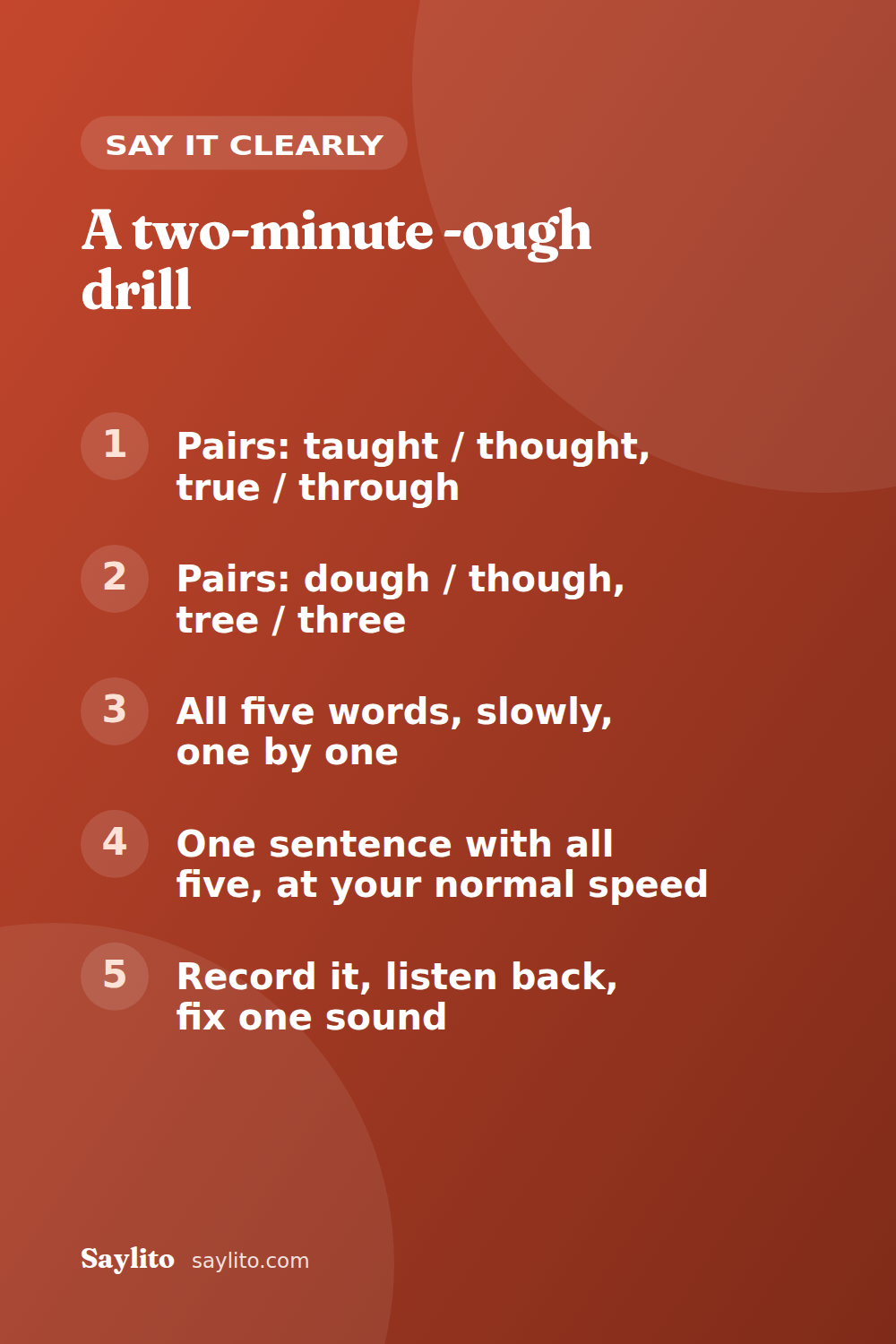
Here's a sentence that uses all five: “I thought it through, though the job was tough and the check had to be thorough.” Say it slowly twice, then at the speed you'd use with a friend. On the playback, listen for one thing at a time: is through still a th and not a t? Does though buzz? Does thorough keep its two syllables?
Each word also has its own page on Saylito, with the model voice at two speeds and three practice sentences: through, though, thought and thorough.
One last thing: don't slow these words down only in sentences where you're nervous about them. A sentence where one careful “thorough” crawls and everything else runs at normal speed sounds odd. Practise them slowly on their own, then put them back into sentences at your own pace. This is practice, not therapy: for a voice or speech problem, see a speech-language pathologist.
Questions people ask
What is the correct pronunciation of “though”?
In American English, /ðoʊ/: DHOH. It starts with the buzzing th of “this” (tongue between your teeth, voice on) and ends with the oh of “go”. The gh is silent, and it rhymes with “go” and “dough”.
How do you pronounce tough, through, thorough, thought, though?
Tough is TUF, /tʌf/. Through is THROO, /θruː/, the same as “threw”. Thorough is THUR-oh, two syllables, /ˈθɝː.oʊ/. Thought is THAWT and rhymes with “taught”. Though is DHOH, /ðoʊ/. Only though starts with the buzzing th, and tough has no th at all.
What is the difference between through and though?
They differ in all three sounds. Through has the quiet th, an r and the oo of “food”: /θruː/. Though has the buzzing th, no r, and the oh of “go”: /ðoʊ/. Through means from one side to the other; though works like “but” or “however”.
What is the correct pronunciation of through?
/θruː/: THROO, one syllable. Start with the quiet th of “think”, go straight into an r, and end on a long oo. It sounds exactly like “threw”. Watch that it doesn't turn into “true”, which starts with a t.
Sources
- Cambridge Dictionary, pronunciation of “through” (US /θruː/), read 2026-11-06
- Cambridge Dictionary, pronunciation of “though” (US /ðoʊ/), read 2026-11-06
- Cambridge Dictionary, pronunciation of “thought” (US /θɑːt/, UK /θɔːt/), read 2026-11-06
- Cambridge Dictionary, pronunciation of “thorough” (US /ˈθɝː.ə/ and /ˈθɝː.oʊ/), read 2026-11-06
- Cambridge Dictionary, pronunciation of “tough” (US /tʌf/), read 2026-11-06
- Cambridge Dictionary, pronunciation of “caught” and “cot” (both US /kɑːt/), read 2026-11-06
- Cambridge Dictionary, pronunciation of “throughout” (US /θruːˈaʊt/), read 2026-11-06
- The CMU Pronouncing Dictionary, Carnegie Mellon University (through = threw; thought, taught, sought and fought with one vowel; thorough and borough), read 2026-11-06
Keep reading
How to Pronounce This, These and Those: Three Words, Sound by Sound
How to pronounce this and these in American English: the buzzing th, the short i or long ee, the s or z at the end, plus those and a five-minute drill.
How to Pronounce Water in American English: Is It “Wooder”?
How to pronounce water in American English: the first vowel, the quick t that sounds like d, and the -er ending, with a UK comparison and a short drill.
How to Pronounce Can't in American English: Telling It Apart From Can
How to pronounce can't in American English: a full vowel, a stress, and a t that is stopped, dropped or ch. See how it differs from can, with a drill.