Sounds
How to Pronounce This, These and Those: Three Words, Sound by Sound

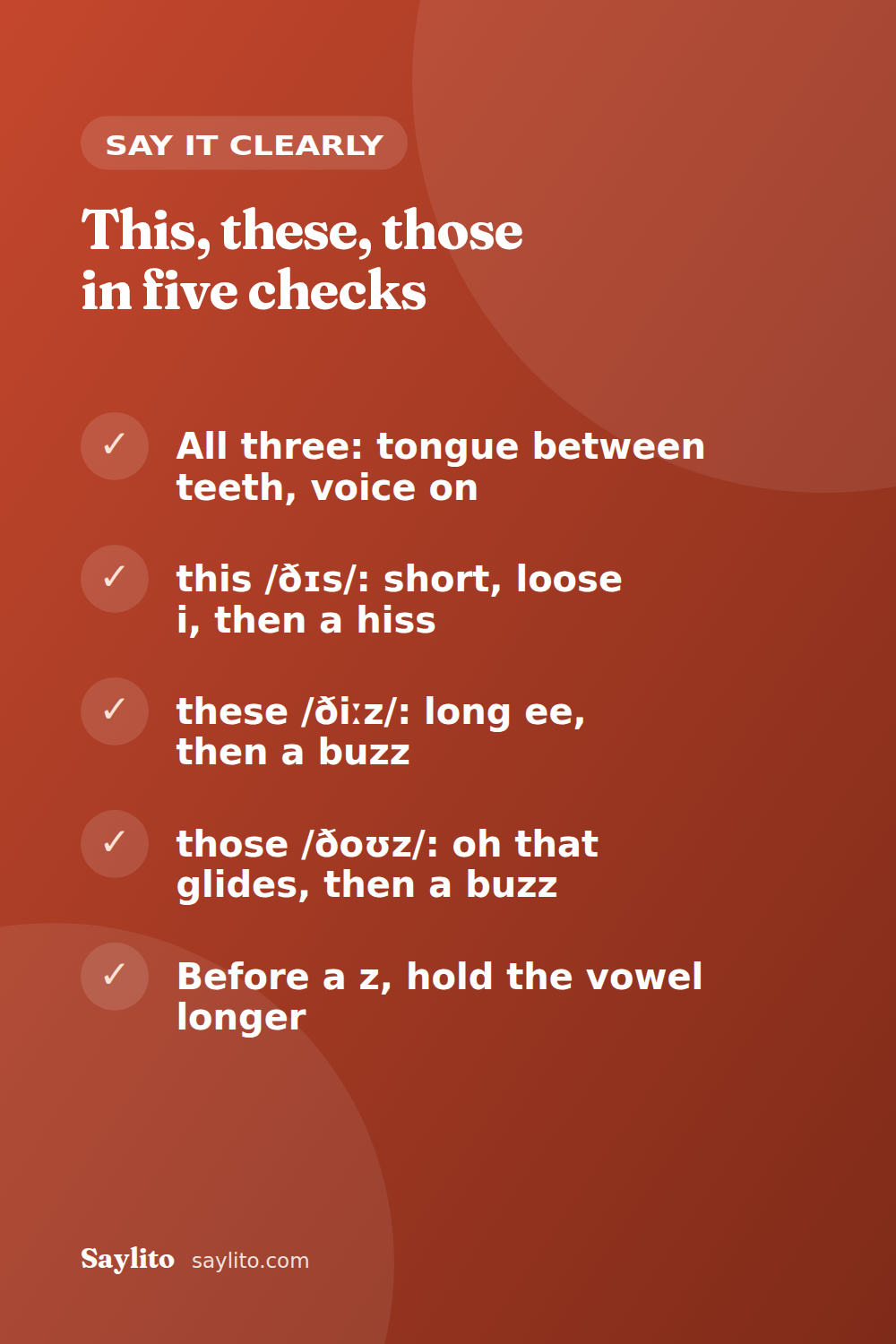
Here is how to pronounce this and these in American English. Both start with the same buzzing th, and they split in two places. This is /ðɪs/: a short, relaxed i (the vowel of "sit") and a hissing s at the end. These is /ðiːz/: a long ee (the vowel of "see") and a buzzing z at the end. Those is /ðoʊz/: the oh of "go", gliding, and the same buzzing z. Get the vowel and the ending right, and a listener hears "one" or "more than one" without having to guess.
That is the short answer. The rest of this post takes the three words apart one sound at a time, shows the swaps a listener notices, and ends with a five-minute drill.
How to pronounce this and these: the quick answer
| Word | IPA (US) | Vowel | End |
|---|---|---|---|
| this | /ðɪs/ | short i, as in sit | s, a hiss |
| these | /ðiːz/ | long ee, as in see | z, a buzz |
| those | /ðoʊz/ | oh, as in go | z, a buzz |
A little grammar explains why the sounds matter. This and that are singular, and these and those are plural. This and these usually point to something close to you; that and those to something farther off.
So when "these" comes out sounding like "this", the listener is not only hearing a different vowel. They are hearing a different number. That is why these little words deserve a few minutes of practice, even though you have said them a thousand times.
The th at the start: one buzzing sound for all three
All three words begin with the voiced th, written /ð/. It is the th of "the", "they" and "mother", and it is the voiced partner of the th in "think": the same tongue position, with your voice switched on, so it buzzes.
- Rest the tip of your tongue lightly between your top and bottom teeth.
- Turn your voice on. With a hand on your throat, you should feel a buzz.
- Let the air keep flowing over your tongue. If your tongue presses and stops the air, you will hear a d.
- Keep it light and quick. In small words like these, your tongue only shows for a moment.
The two usual swaps are a d ("dis", "dese", "dose") and a z ("zis", "zese"). In a sentence, most listeners will still follow you, so this is not a reason to freeze up mid-word. But "those" said with a d becomes "doze", a different real word, and swaps that land on real words are the ones worth fixing first. You can practise it with pairs like they and day, then and den, those and doze in the voiced th drill.
A quick self-check: say "breathe" and hold the end. You should hear a steady buzz you could keep going as long as you have air. A d cannot be held at all. A z can, but for a z your tongue sits behind your teeth, not between them.
The vowel: the short i of this, the long ee of these
This is the part most people mean when they search for this vs these. English has two vowels where many languages have one i: the short i of "ship", "sit" and "this", and the long ee of "sheep", "seat" and "these". Phonetics calls the pair lax and tense.
For these, your tongue is high and forward, close to the roof of your mouth without touching it, and the vowel is long. For this, let your tongue drop a little, toward the e of "bed", and keep your lips loose. Do not smile or stretch your lips for this. A wide smile pulls the vowel back up toward ee.
A finger under your chin helps. Say "these", then "this". For this, your jaw drops a tiny bit. If both feel exactly the same, you are most likely saying the same vowel twice. To practise the pair, work through more words and two short sentences in the ship or sheep drill.
A swap listeners notice
Saying "this" with the long ee of "these". The listener hears a plural word in front of one thing ("these book") and has to stop and work out what you meant. The fix is a shorter, looser i, not a different word.
The ending: s in this, z in these and those
Look at the spelling and you would expect all three to end the same way. They do not. This ends in a hissing s. These and those end in a buzzing z, even though the letter is s, the same way "is", "was" and "his" end in a z.
A z at the end of an English word often loses some of its buzz, so listeners lean on a second clue: the vowel before it. In American English, a vowel before a voiced consonant such as z lasts almost twice as long as the same vowel before a voiceless one such as s. Say miss and Ms, or ice and eyes, and you can hear the difference.
So the vowel in these is doing two jobs. It is long because ee is a long vowel, and it gets longer still because a z follows. That extra length is a big part of what a listener hears. If your z comes out weak, hold the vowel a little longer and the word still comes across as these.
To feel the buzz, put your fingers on your throat and say "sss", then "zzz", without stopping the air. On the z you feel a buzz under your fingers; on the s, nothing. Then try the endings on their own: "this-sss", "these-zzz". For more pairs with the same sound, practise with the zoo or sue drill.
Those: the vowel that glides
Those is /ðoʊz/. The th and the z work just as they do in these. What is new is the vowel: the oh of "go" and "phone", which in American English is a glide, not one still sound. It starts at an o and slides toward the u of "put", as the two symbols in /oʊ/ show.
Two swaps come up here. One is a short, flat o with no glide, which makes those sound clipped. The other is a hissing s at the end, borrowed from this. Keep the glide, keep the buzz, and give the vowel its extra length before the z, the same as in these.
And that, for completeness, is /ðæt/: the buzzing th, the a of "cat", and a t. In fast speech you'll also hear a weak form, /ðət/.
This or these in a sentence: what a listener hears
In a sentence, the noun after the word often helps a listener. "These books" says plural twice: once in these, and again in the s of books. The hard case is when the word stands alone. In "Can I take these?" or "Is this yours?", the vowel and the ending are the only clues to whether you mean one thing or several. That is where the short i and the hiss, or the long ee and the buzz, really count.
Read these pairs aloud, slowly first, then at your normal speed:
- Is this yours? / Are these yours?
- I'll take this one. / I'll take these two.
- This is the last stop. / These are the last seats.
- Those are my keys, not these.
- We tried this last week, and those ideas too.
Speed changes things, and that is normal. At a natural pace your tongue only touches your teeth for an instant on the th, and the vowel of this gets shorter still. What should survive at full speed is the contrast: short and hissing for this, long and buzzing for these and those.
One more tip: do not slow these words down only when you are worried about them. A sentence where every word runs at the same speed except one careful "these" sounds odd. Practise slowly, then put the words back into sentences at your normal pace.
A five-minute drill for this, these and those
Five minutes a day is plenty for three words. Use your phone to record yourself. Listening back is where most of the learning happens, because it is hard to hear your own vowels while you are making them.

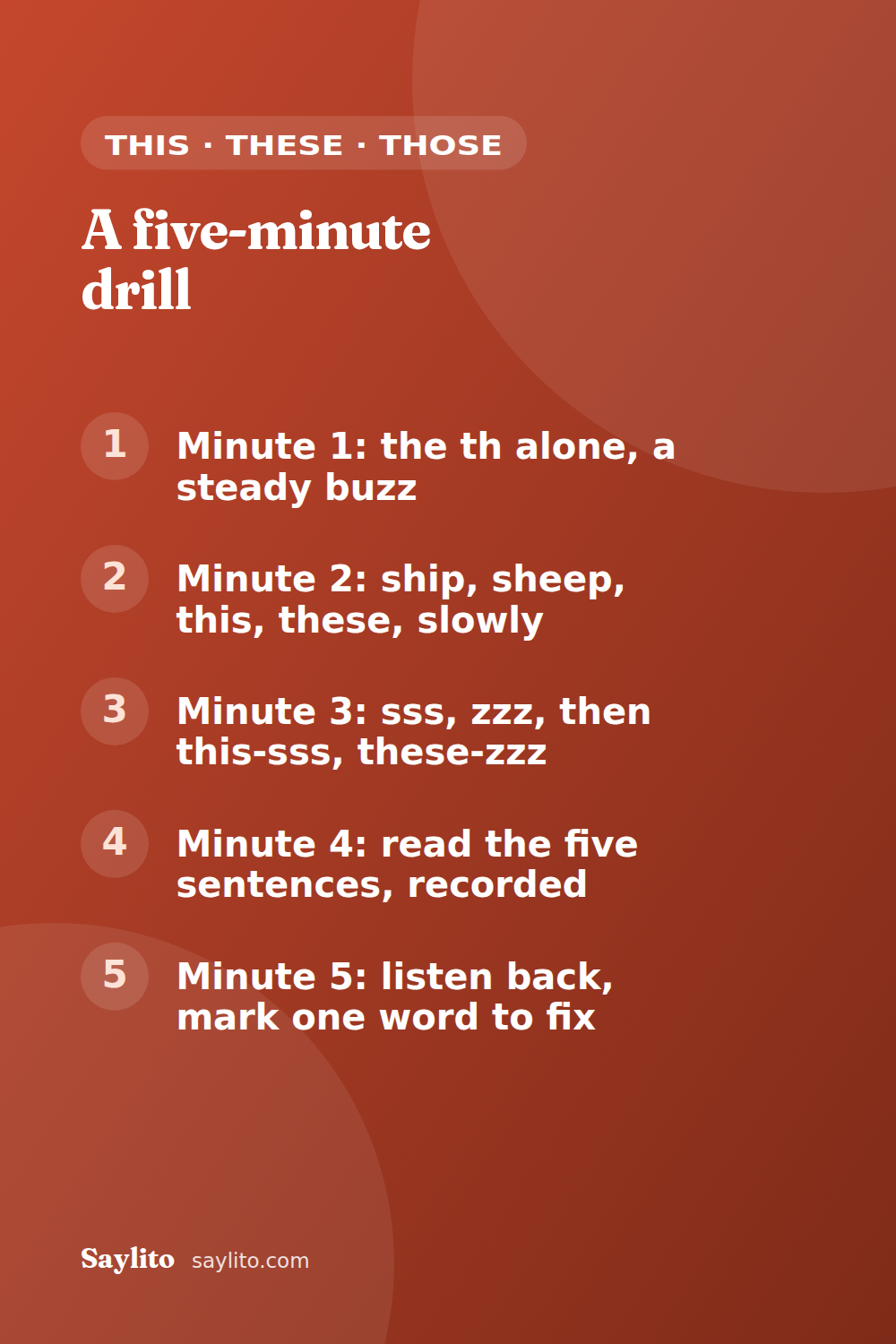
Each minute aims at one of the three differences, so when a word goes wrong you know which part to work on. If it is the th, go back to the th drill. If it is the vowel, the ship or sheep drill. If it is the ending, the zoo or sue drill. Keep the fix small: one sound, one week.
Not sure which sound to start with? The free accent test has you read six short sentences aloud and shows the sounds a listener may miss, to practise first. Its result is practice feedback, never a grade. The goal is being understood easily, not sounding like anyone else. Saylito is practice, not therapy: for a voice or speech problem, see a speech-language pathologist.
Questions people ask about this and these
How do you pronounce "this" and "that"?
Both start with the buzzing th: tongue tip between your teeth, voice on. This is /ðɪs/, with the short i of sit and an s at the end. That is /ðæt/, with the a of cat and a t. In fast speech you'll also hear a shorter /ðət/ for that.
Do you say "these" or "this"?
It depends on how many things you mean. This and that are singular; these and those are plural. Say this for one thing (/ðɪs/: short i, then a hiss) and these for more than one (/ðiːz/: long ee, then a buzz).
Is it EE-ther or EYE-ther?
Both are heard in American English: EE-ther, /ˈiː.ðɚ/, and EYE-ther, /ˈaɪ.ðɚ/. Either way, the th in the middle is the same buzzing th as in this. You can hear it at two speeds on the how to say either page.
Sources
- Cambridge Dictionary, "this" (American English: /ðɪs/; this, that, these and those as demonstratives), read 2026-11-03
- Cambridge Dictionary, how to pronounce "these" (US /ðiːz/), read 2026-11-03
- Cambridge Dictionary, "those" (US /ðoʊz/), read 2026-11-03
- Cambridge Dictionary, "that" (US /ðæt/, weak form /ðət/), read 2026-11-03
- Cambridge Dictionary, how to pronounce "either" (US /ˈiː.ðɚ/, /ˈaɪ.ðɚ/), read 2026-11-03
- An Introduction to American English Phonetics, 6.6 Pre-fortis clipping (University of Groningen open textbook): vowel length before voiced and voiceless consonants
Keep reading
How to Pronounce Through, Though, Thought, Tough and Thorough in American English
How to pronounce through, though and thought in American English, plus tough and thorough: five -ough words, five sounds, and the slips listeners hear.
How to Pronounce Water in American English: Is It “Wooder”?
How to pronounce water in American English: the first vowel, the quick t that sounds like d, and the -er ending, with a UK comparison and a short drill.
How to Pronounce Can't in American English: Telling It Apart From Can
How to pronounce can't in American English: a full vowel, a stress, and a t that is stopped, dropped or ch. See how it differs from can, with a drill.