Pronunciation
How to Pronounce Water in American English: Is It “Wooder”?
In American English, water is said with three parts: a first vowel like the one in father or thought, a quick tap of the tongue where the t is written, and a closing -er that has no separate r sound to chase. Together it comes out close to “WAH-der” or “WAW-der,” with a d-like middle. The tap is the part that surprises learners, because the spelling promises a full t. It's a regular feature of American speech, and once you can hear it you'll catch it in dozens of other everyday words.
How to pronounce water in American English: the short answer
- The first vowel: /ɑ/ (the a of father) or /ɔ/ (the aw of thought), depending on the speaker. Both are understood. Two East Coast cities say something closer to the oo of book.
- The t: between two vowels, with the stress before it, it becomes one quick tap, so “water” sounds close to “wadder.”
- The ending: a short -er, /ɚ/, with the tongue pulled back a little and nothing touching.
- The stress: on the first syllable, WA-ter. The second is weak and short.
- Your safest move: say the first vowel long, tap the middle, and make the ending quick.
In American dictionary notation the word is /ˈwɑː.t̬ɚ/. The small mark under the t stands for the quick American t, and the stress mark sits before the first syllable.
Is it water or wooder? The first vowel
People spell it “wooder” because the first syllable doesn't sound like the wa in wag. That's a fair thing to notice. In water, the w is followed by a back vowel, and which one depends on where the speaker grew up.
| Where you hear it | First vowel | Sounds a bit like |
|---|---|---|
| Many US speakers, with the cot–caught merger | /ɑ/ | the a of father |
| Parts of the US without that merger | /ɔ/ | the aw of thought |
| Baltimore and Philadelphia | /ʊ/ | the oo of book |
| Standard British English | /ɔː/ | a long aw |
The cot–caught merger just means many Americans say cot and caught with the same vowel, which makes “wah-der” a very common sound. Baltimore and Philadelphia have their own “wooder,” with the oo vowel of book, so it isn't a mistake. It's one regional way to say the word.
For a learner, I'd pick one and stay with it. The /ɑ/ version is the one American dictionary notation shows, and listeners across the US will hear it as water. Open your mouth wide, keep your lips relaxed and unrounded, and say the a of father.
Do Americans pronounce the t in water? The quick tap
Mostly not as a full t. When a t sits between two vowels and the second vowel is weak, American speakers turn it into a quick tap of the tongue tip on the ridge behind the top teeth. The voice stays on, no puff of air comes out, and the sound is so short that many listeners hear a d. Linguists call it flapping, and it's why butter can be heard as “budder.”
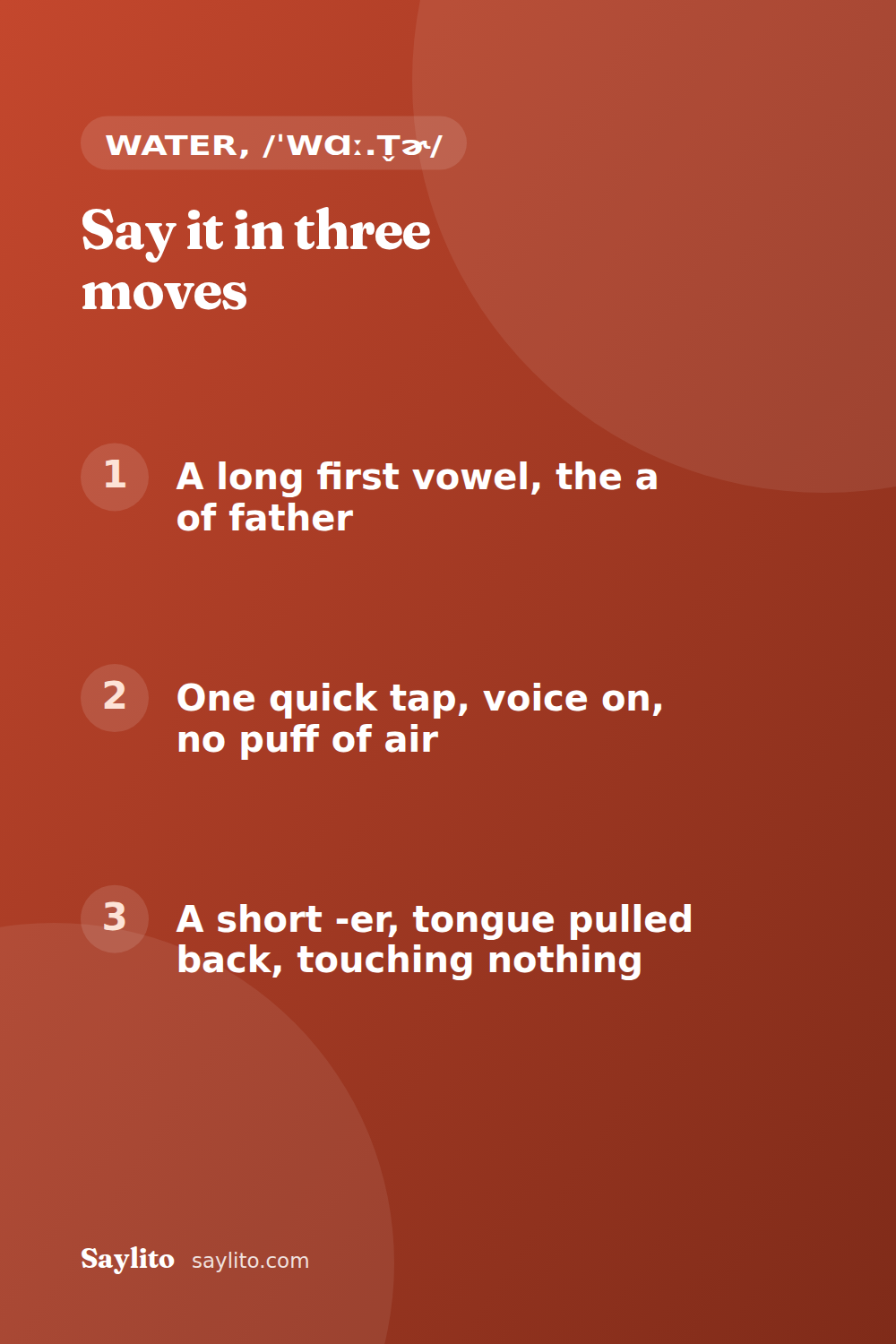
To make the tap, say the first vowel and keep your voice running. Flick the tip of your tongue up to the ridge just behind your top teeth and let it drop at once. It should be much shorter than a d you'd hold. Then go straight into the ending without a pause. Our flap t page has the same move drawn step by step, with audio to copy.
A full, clear t isn't wrong. It's what the spelling shows, and a listener will still understand water. It just sounds careful, and a little less American.
The -er ending: a short vowel with no hard r
The last syllable is easy to over-work. In American English it's one r-colored vowel, written /ɚ/, the same sound as the end of paper, butter and later. The tongue tip curls back a little or bunches up, and it doesn't touch the roof of the mouth. The vowel is weak, so it's quick and quiet.
Many learners add a clear vowel before the r, saying something like “wa-ter-uh,” or they roll the r. Both make the word longer than it should be. Think of the syllable as a short hum with the tongue pulled back, and let it fade. The er in paper page shows the same sound in a word without a tap to worry about.
How the UK says water
British English makes three different choices. The UK form is /ˈwɔː.tə/: a long aw, a real t and a schwa at the end. In Received Pronunciation the t often has a small puff of air after it, and the final r isn't said. That's why a British speaker's water sounds longer in the middle and sharper on the t.
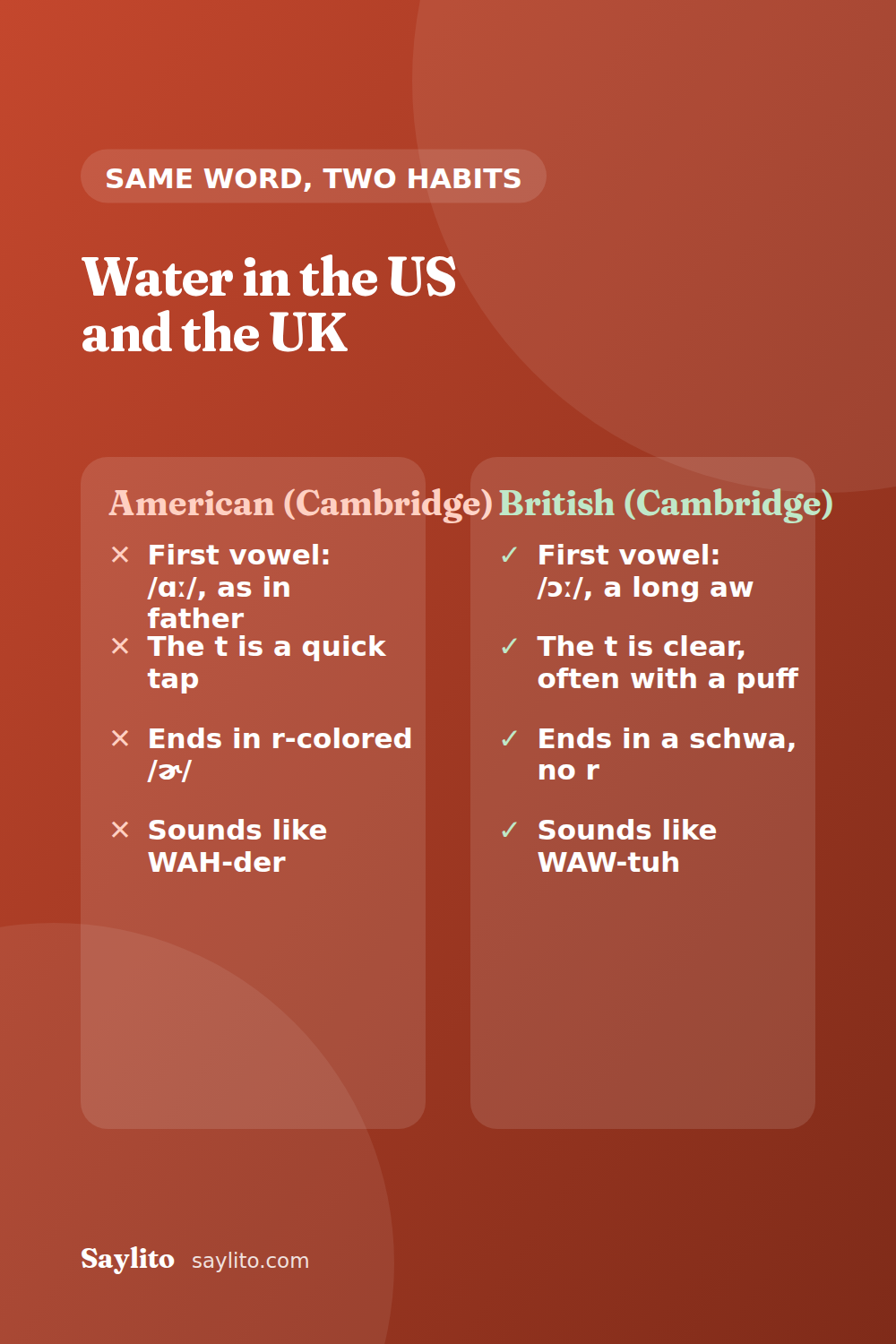
Australian English taps too, so the tap isn't only American. If your own English teacher or favorite podcast has a British accent, that's why the American recordings can sound so different at the t.
Other words that follow water: a short list
Water isn't special. The same tap shows up wherever the t sits between two vowels and the second one is weak. These everyday words all work that way.
| Word | American (Cambridge) | What the t does |
|---|---|---|
| butter | /ˈbʌt̬.ɚ/ | a quick tap |
| better | /ˈbet̬.ɚ/ | a quick tap |
| city | /ˈsɪt̬.i/ | a quick tap |
| meeting | /ˈmiː.t̬ɪŋ/ | a quick tap |
| daughter | /ˈdɑː.t̬ɚ/ | a quick tap, same first vowel as water |
| waiter | /ˈweɪ.t̬ɚ/ | a quick tap |
| computer | /kəmˈpjuː.t̬ɚ/ | a quick tap, after the stressed syllable |
| potato | /pəˈteɪ.t̬oʊ/ | the first t is clear, the second taps |
| bottle | /ˈbɑː.t̬əl/ | a quick tap before the weak ending |
Potato has two t's, and only the second one taps, because the first sits before a stressed vowel. That's the rule in one word: a t that starts a stressed syllable stays a clear t, and a t that sits between a stressed vowel and a weak one taps.
Where the t stays a t
The tap needs a vowel on each side, with the stress before the t. Take that away and the t comes back.
| Word | American (Cambridge) | Why it stays a clear t |
|---|---|---|
| attend | /əˈtend/ | the vowel after it is stressed |
| hotel | /hoʊˈtel/ | the vowel after it is stressed |
| after | /ˈæf.tɚ/ | an f comes before the t, so no vowel on that side |
| top | /tɑːp/ | the t starts the word |
The tap also crosses word boundaries. A t at the end of one word followed by a vowel at the start of the next often taps too, as in get over or a lot of. So in “a glass of water” the middle of water taps, and in “can I get a water?” the t of get taps right into the a. Say each phrase at an easy pace and you'll feel the tongue move once and drop.
A five-minute drill for water
You only need a glass of water, a phone and five minutes. Go one step at a time and keep the voice on through each word.
- Say the first vowel alone. Open your mouth and hold the a of father for two seconds, then add the w in front: wah, wah, wah.
- Tap, don't stop. Say “wah” and flick the tongue tip up and down once, going straight on to the next vowel: wah-der. If your tongue rests on the ridge, the d is too heavy.
- Shrink the ending. Say wah-der three times, each shorter in the last syllable. The last one should be almost a hum.
- Pair it with its neighbors. Read this list out loud: water, butter, better, city, meeting, later. Keep the same quick tap in each one.
- Put it in phrases. Say “a glass of water,” “water for the table,” “can I get a water?” and “how much water?”
- Record and compare. Record yourself on your phone, then play a dictionary's American audio next to it. Listen for the voice that never stops in the middle of water.
Do it once a day for a week. The tap carries over into the other words on the list without extra effort, so each one you add gets easier. If you'd like to find out which sounds to work on first, Saylito's free accent test listens to a few sentences and points to where your speech stands. For a voice or speech problem, see a speech-language pathologist.
Questions people ask about saying water
Is it water or wooder?
Water. “Wooder” is a respelling of one regional way to say it, with an oo-like first vowel, heard in Baltimore and Philadelphia. Many Americans say a first vowel like the a of father (or the aw of thought) and a quick tap in the middle.
Do you pronounce the t in water?
Not as a full t in American English. Between two vowels, with the stress before it, the t becomes one quick tap of the tongue, so water sounds close to wadder. A clear t is still understood and is the British habit.
How do the UK say water?
The UK form is /ˈwɔː.tə/: a long aw, a clear t that often has a small puff of air, and a schwa at the end with no r sound.
Sources
- Cambridge Dictionary: water (US /ˈwɑː.t̬ɚ/, UK /ˈwɔː.tə/; read 2026-11-24)
- Cambridge Dictionary: butter, better, city, meeting, daughter, waiter, computer, potato, bottle (read 2026-11-24)
- Cambridge Dictionary: attend, hotel, after (read 2026-11-24)
- Wiktionary: water, pronunciation (General American with and without the cot–caught merger, Baltimore and Philadelphia, RP, Australia; read 2026-11-24)
- Wikipedia: Flapping (conditions for the American tap; read 2026-11-24)
Keep reading
Words Americans Pronounce Differently: 32 Everyday Words, US vs UK, by Pattern
Words Americans pronounce differently from British English, sorted by the pattern behind them: 32 everyday words with UK and US IPA side by side.
General American Accent: The Features That Help You Be Understood
The General American accent, explained for learners: what it is, which of its sounds help listeners understand you, and which ones you can safely skip.
How to Pronounce Can't in American English: Telling It Apart From Can
How to pronounce can't in American English: a full vowel, a stress, and a t that is stopped, dropped or ch. See how it differs from can, with a drill.