Pronunciation
How to Pronounce Can't in American English: Telling It Apart From Can

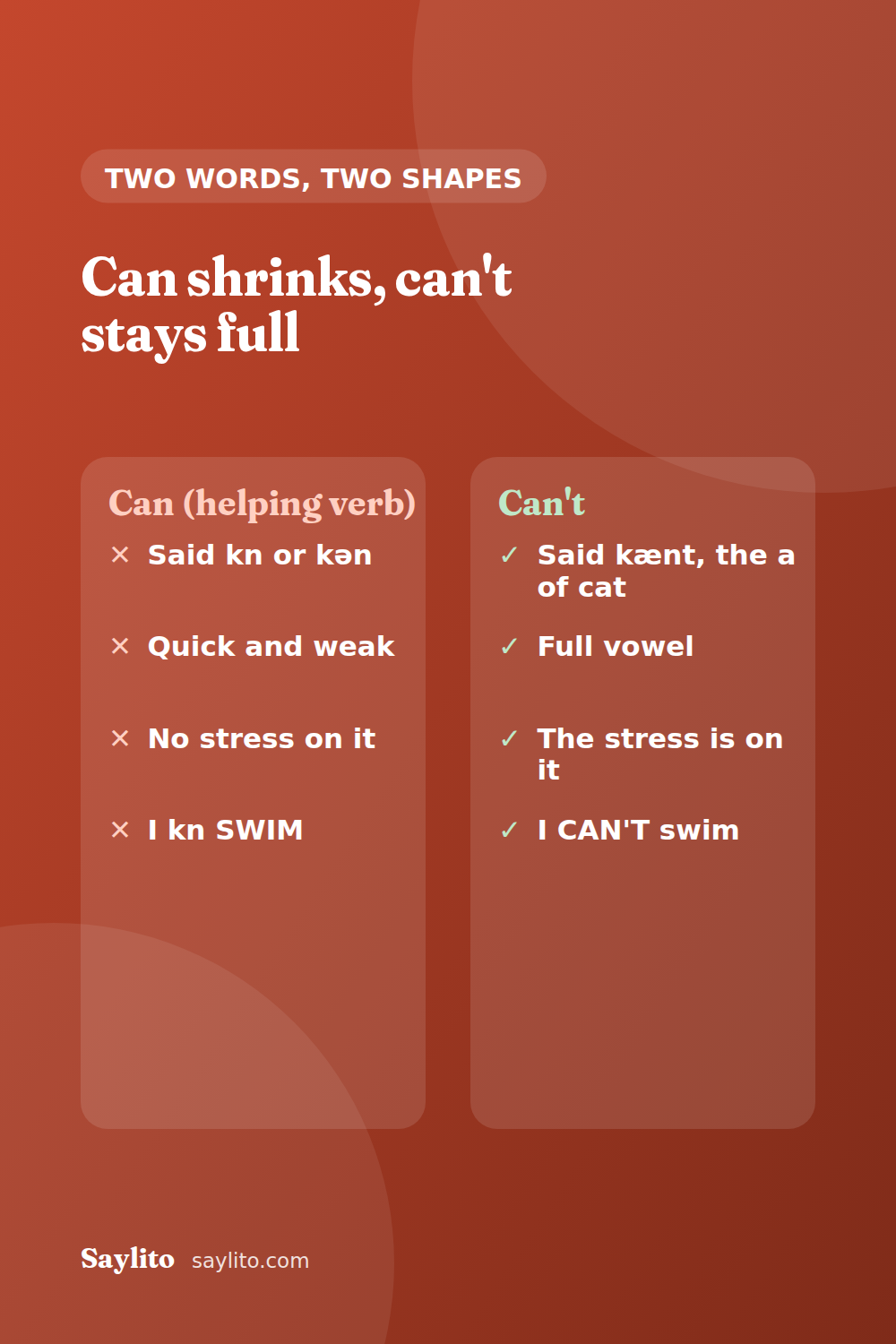
In American English, can't is said with a full vowel, the a of cat, and the speaker puts the stress on it. The t at the end is often only a quick stop in the throat, or it isn't said at all. The helping verb can is the opposite: a short, weak kn that is easy to miss. So the difference between the two is hardly ever the t. It's the vowel and the stress. Give can't a full vowel and a clear beat, let can shrink, and a listener will hear which one you mean.
How to pronounce can't in American English: the short answer
- Can't has one pronunciation to learn. The dictionary gives /kænt/, with the a of cat, and no reduced version.
- Can usually shrinks. The helping verb is said /kən/ or even /kn/, with no stress, so the verb after it gets the weight.
- The t is the unreliable part. Before another consonant it is a stop, before a vowel it often disappears, and before you it can turn into ch.
- A can of soup is a different word. The noun keeps the full vowel, /kæn/, in every sentence.
- Your safest move: say can't with a full vowel and a stress, say can quickly, and don't depend on the t.
The spelling shows a t, so it's natural to wait for one. In everyday American speech that wait often ends in silence, and that is why can and can't can sound alike to a learner's ear.
Can in a sentence: the weak form that nearly disappears
The helping verb can has two shapes. The strong one, /kæn/, has a full vowel and is used when the word is stressed. The weak one, /kən/, is used when it isn't, and in American speech it often shrinks even further, to /kn/, with almost no vowel at all.
In “I can swim,” the stress falls on swim, and can drops to a quick kn: I kn SWIM. The vowel in the middle is the schwa, the weakest vowel English has, and you can hear more about it on the schwa sound page.
The full vowel comes back when can is stressed. That happens when someone says the word alone, when a speaker presses it for emphasis (“I CAN do it”), and at the end of a sentence or phrase, as in “Yes, I can.” The noun does the same: a can of beans is /kæn/ every time.
| Sentence | What you hear | Which word |
|---|---|---|
| I can swim. | I kn SWIM | can, weak |
| I can't swim. | I CAN'T swim | can't, full vowel |
| Yes, I can. | yes I CAN | can, strong at the end |
| A can of beans | a CAN of beans | the noun, full vowel |
Can't keeps its full vowel and the stress
The dictionary entry for can't gives one pronunciation, /kænt/, and no weak form. That's the whole trick: can't never shrinks. The vowel is the a of cat, with the mouth open wide and the tongue forward. The cat, cut and cot page has a short drill for that vowel.
The stress follows from what the word does. Can't is the part of the sentence that changes the meaning, so a speaker says it clearly: I CAN'T go, we CAN'T wait, she CAN'T see it. The words around it stay light.
That's why a quick test works better than waiting for a t. Say “I can come” and “I can't come” side by side. The first has a small kn and a loud COME. The second has a loud CAN'T and a softer come.
How to hear the difference when someone speaks fast
When the t is hard to catch, three other clues carry the load.
- Which word is loud? If the verb after it is loud and the small word before it is a blur, it's can. If the small word itself is loud and full, it's can't.
- What is the vowel? A kn or kən with almost no vowel means can. The a of cat means can't.
- What does the sentence need? “I can't wait” and “I can wait” can mean opposite things, so the rest of the sentence usually settles it.
Questions follow the same pattern. In “Can you help me?” the small can shrinks to kn and the weight lands on help. In “Can't you help me?” the full CAN'T comes first, and it is the word the listener hears first. If you hear a loud, full vowel at the very start of a question, it's can't.
Short answers work the other way around. “Yes, I can” ends on can, so the word keeps its full vowel, while “No, I can't” ends on a word that was full from the start. At the end of a sentence the two sound closest, so the answer before it, yes or no, does most of the work.
Where the t goes in can't: stopped, dropped or ch
American speakers often don't release a t at the end of a word or before another consonant. Instead they close the throat for an instant. Linguists call it t-glottalization, and it happens in words like cat, which can sound like “ca” with a catch at the end. The catch is the same one you make in the middle of “uh-oh.”
| Next word starts with | What happens | Example |
|---|---|---|
| A consonant | A stop: the throat closes, no puff of air | I can't go |
| A vowel | The t often disappears | I can't even try |
| you or your | The t often turns into ch | Can't you see it? |
| Nothing (end of the sentence) | A stop, or a light t | I just can't. |
The ch pattern isn't special to can't. When a t meets you, the two sounds often blend into ch across the word boundary, the way got you becomes “gotcha” and what are you becomes “whatcha.” That blend is called yod-coalescence. So “Can't you see it?” sounds close to “Can-chu see it?”
A clear, released t isn't wrong. It's what the dictionary shows, and any listener will understand it. It's just not what you'll usually hear in fast speech, and that's why waiting for one makes can't sound like can.
How to say can't in three moves
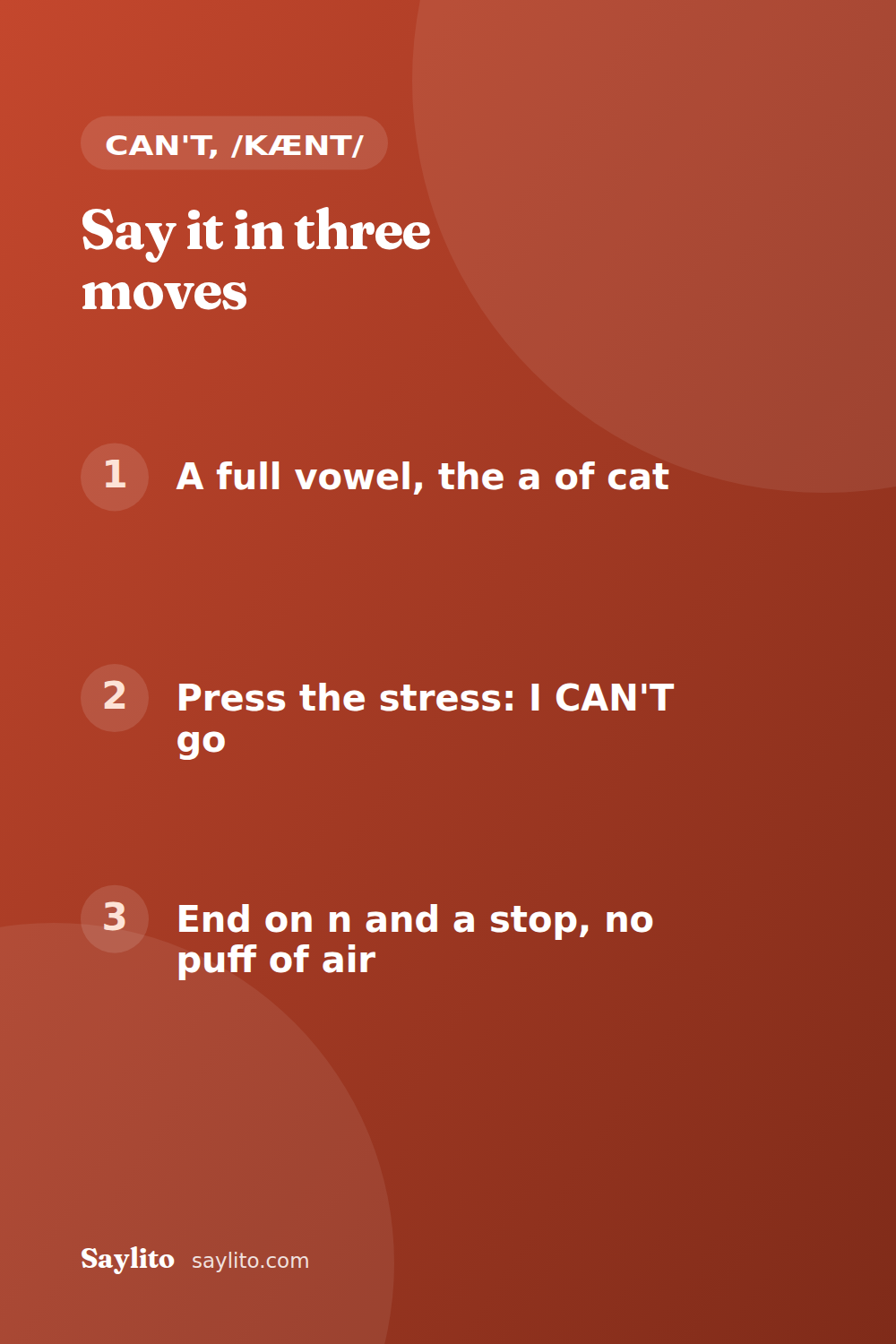
- Open for the a of cat. Start with k, then open your mouth wide with the tongue forward, the same vowel as in cat and have.
- Press the stress. Make the syllable a little louder and longer than the words around it: I CAN'T go.
- Close the word with n and a stop. Let your tongue rest on the ridge behind your top teeth for the n, then close your throat for an instant, as in uh-oh. You don't need a t with a puff of air.
For can, do the opposite. Skip the wide mouth, drop the stress and run it straight into the verb: kn SWIM, kn COME, kn SEE. If you say a full CAN there, a listener may hear can't, or hear you stressing can for emphasis.
The t of other words follows its own rules. Between two vowels it often becomes a quick tap, as in water or city, and the flap T page shows how to make it. In can't the tap isn't the main event: the vowel and the stress are.
A five-minute drill for can and can't

Read each pair out loud. Say the first sentence with a quick, weak can and the second with a full, stressed can't.
- I can swim. / I can't swim.
- She can come. / She can't come.
- We can go now. / We can't go now.
- They can see it. / They can't see it.
- You can park here. / You can't park here.
- Say each pair again with your hand on the table. Tap on the loud word: SWIM in the first sentence, CAN'T in the second.
- Try three sentences with a different next word: “I can't go,” “I can't even try,” “Can't you see it?” Let the t stop, fade and turn into ch in turn.
- Record the whole set on your phone and play it back. Listen for a short kn in every can sentence and a full a in every can't sentence.
- Finish with “Yes, I can” and “No, I can't.” In the first, can ends the sentence, so it keeps its full vowel. In the second, can't does what it always does.
Do the set once a day for a week and the two words will start to sound different to you in other people's speech too. If you'd like to see which sounds to practice first, Saylito's free accent test listens to a few sentences and shows where your speech stands. For a voice or speech problem, see a speech-language pathologist.
Questions people ask about can and can't
What is the difference in pronunciation between “can” and “can't”?
In American English the helping verb can is usually weak, /kən/ or /kn/, with no stress. Can't has a full vowel, /kænt/, and the stress. The t is often only a stop in the throat, so the vowel and the stress carry the difference.
How do Americans pronounce their T?
It depends on where the t sits. Between two vowels, after a stressed vowel, it often turns into a quick tap, so water sounds close to wadder. At the end of a word or before another consonant it is often a stop, with a catch in the throat instead of a puff of air. At the start of a stressed syllable, as in top or attend, it is a clear t.
How can I say I can't?
Stress the word and keep the full vowel: I CAN'T. Say the a of cat, end on n, and close your throat for a moment instead of adding a strong t. Context helps a listener too: I can't come, I can't wait.
Sources
- Cambridge Dictionary: can (strong /kæn/, weak /kən/ and /kn/; read 2026-11-23)
- Cambridge Dictionary: can't (/kænt/; read 2026-11-23)
- Wikipedia: Stress and vowel reduction in English (weak and strong forms; read 2026-11-23)
- Wikipedia: T-glottalization (American patterns; read 2026-11-23)
- Wikipedia: Glottal stop (read 2026-11-23)
- Wikipedia: Yod-coalescence (read 2026-11-23)
- Wikipedia: Flapping (read 2026-11-23)
- Rachel's English: Do NOT say can't with a T (the four ways Americans say can't; read 2026-11-23)
Keep reading
Words Americans Pronounce Differently: 32 Everyday Words, US vs UK, by Pattern
Words Americans pronounce differently from British English, sorted by the pattern behind them: 32 everyday words with UK and US IPA side by side.
Hard Words to Pronounce in English: 27 Everyday Words and Why They Trip You Up
Hard words to pronounce in English that you actually use: 27 everyday words in five groups, why each one is hard, and how Americans say it, in IPA.
General American Accent: The Features That Help You Be Understood
The General American accent, explained for learners: what it is, which of its sounds help listeners understand you, and which ones you can safely skip.