Accent
General American Accent: The Features That Help You Be Understood

The General American accent (GA, or GenAm) is the broad, middle-of-the-road accent of American English, the one most Americans hear as having no strong regional, ethnic or social flavor. It isn't one city's accent, and nobody owns it. It's a family of features, like the r at the end of car, the quick, d-like t in water, and lots of weak "uh" vowels. For a learner, the useful question isn't how to copy all of it. It's which of those features help a listener understand you, and which ones you can leave alone.
So here's what General American is, where the idea comes from, what research says about accents and understanding, and a sorted list: four features worth your practice time, two that are optional, and two that Americans themselves don't agree on. One note before we start: this is practice, not therapy. For a voice or speech problem, see a speech-language pathologist.
What is the General American accent? The short answer
General American is the umbrella accent of American English, the one a majority of Americans use, and it covers a continuum, not one fixed accent. Americans with more years of education, or from the North Midland, Western New England and the West, are the ones most often heard as speaking it.
The name goes back to 1925, when the American English scholar George Philip Krapp described a type of American speech that was "Western" but "not local in character". You'll also see it called Standard American, or Broadcast English and Network English, because it's tied to the speech of North American radio and TV announcers. Strictly, Standard American English can include grammar and vocabulary too, while General American is only about how words sound.
One more surprise: standard Canadian English accents are often grouped with General American when they're compared with British English. If you're aiming at North American English in general, this is the same target.
Where General American is spoken, and why nobody owns it
The term is a handy yardstick for comparing accents, not an exact description of anyone's speech. Real Americans who "have" a General American accent still differ from each other on several sounds.
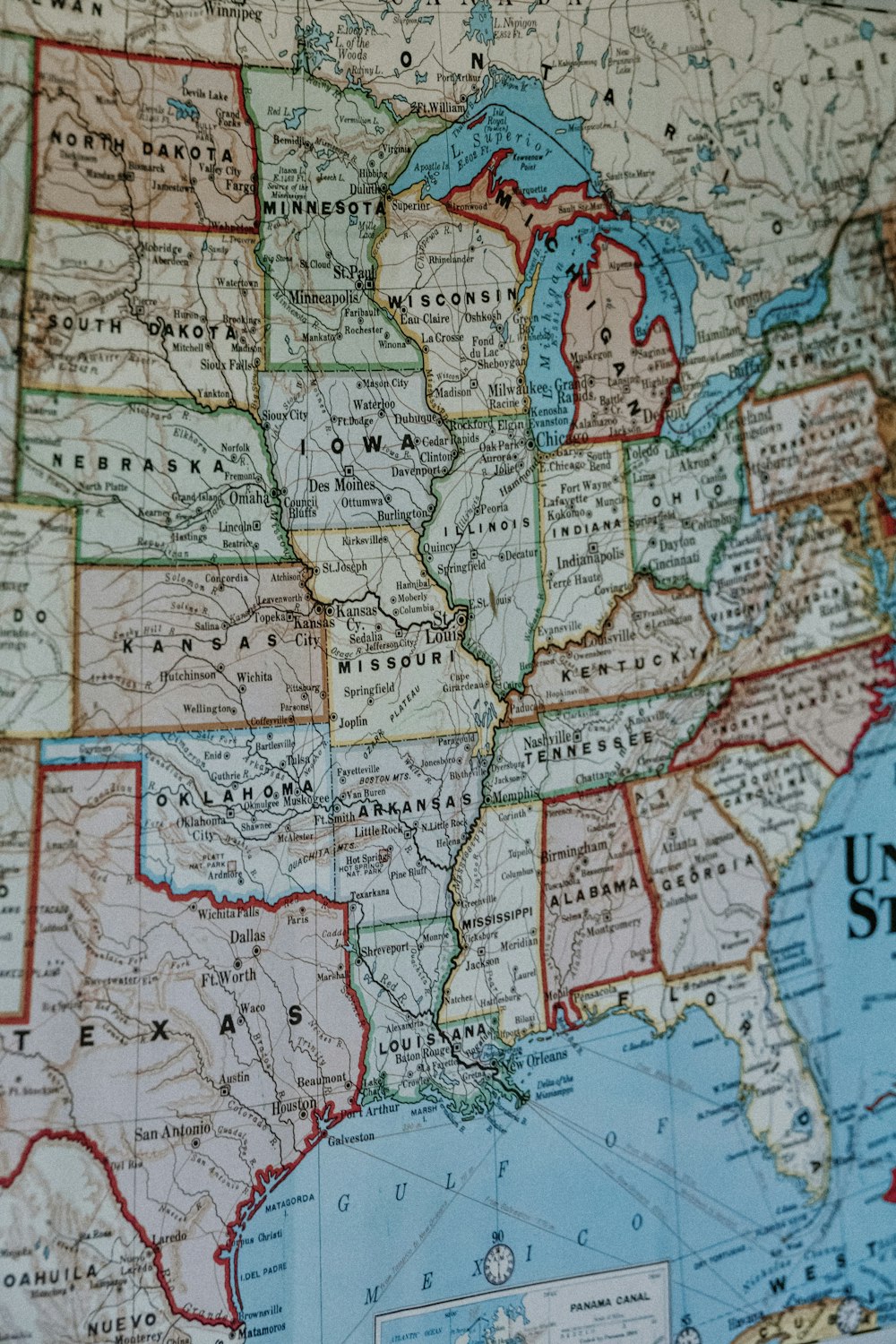
Take Mary, marry and merry. For some Americans those are three different words to the ear. For others they sound exactly the same: nearly 57% of the people from around the country who took a 2003 dialect survey said they merge them. Or take cot and caught: many Americans say them the same way, and many don't. Both groups count as General American.
That's good news for you. There's no single perfect target to hit, so you don't have to chase every detail. You can pick the features that make a real difference to the person listening.
Do you need a General American accent to be understood?
No. How strong an accent sounds and how easy it is to follow are two different things, and a classic 1995 listening test shows it. Twenty native English listeners heard simple true-or-false sentences from 10 native English speakers and 10 Mandarin speakers, answered each one, and rated how strong the accent was and how easy the sentence was to understand.
The sentences they rated hard to understand took them longer to process. How strong the accent sounded showed no link to that time. So you can keep a clear accent and still be easy to understand.
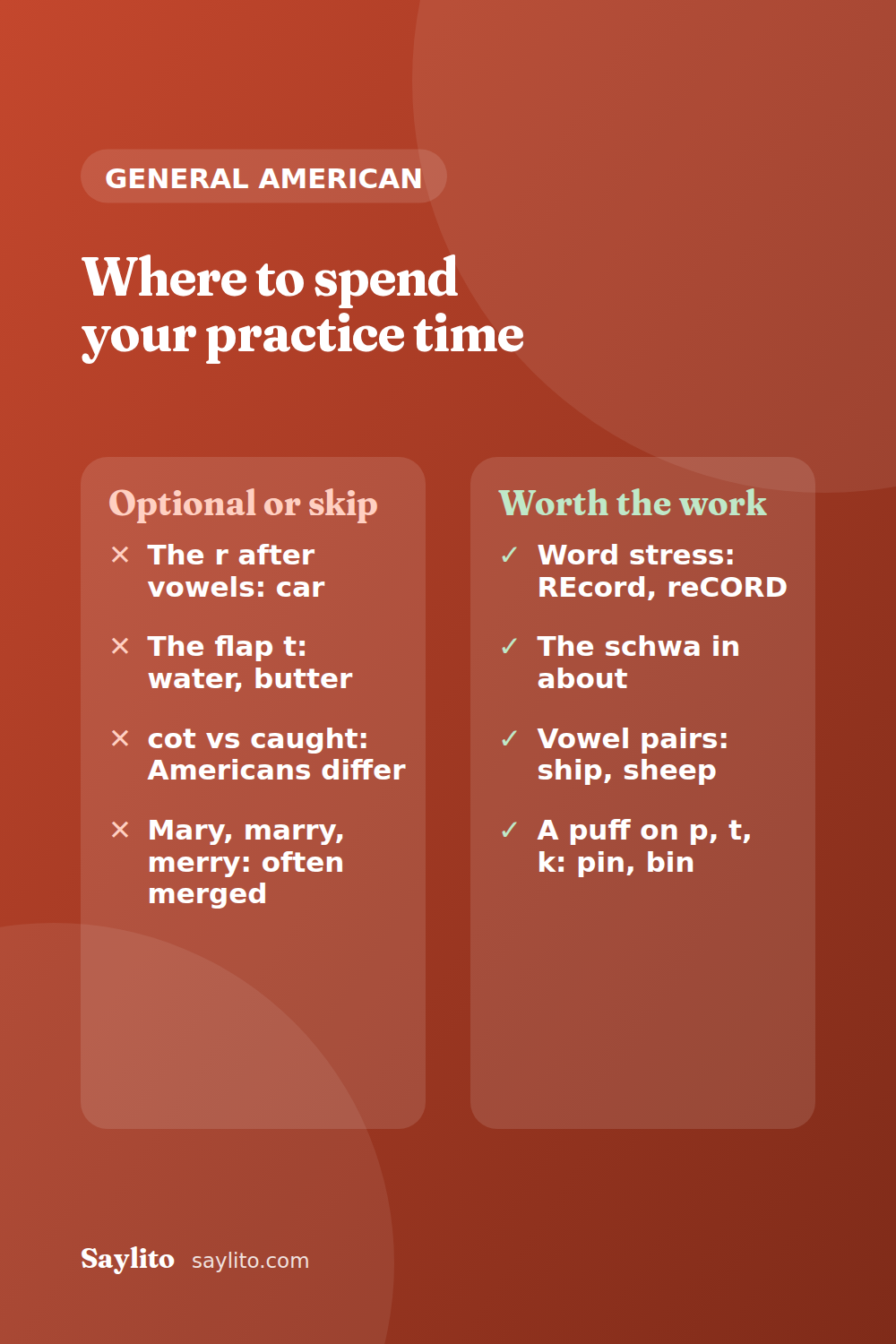
So the goal is to be understood easily, not to sound like anyone else. Some General American features carry meaning, and changing them helps a listener. Others are mostly flavor. Here's how they sort out:
Worth the work: word stress and the schwa
In English, the stressed syllable is longer, louder and a little higher than the rest, and moving it can change the word. Record the noun is /ˈrek.ɚd/ (REK-erd), and record the verb is /rɪˈkɔːrd/ (rih-KORD). Same letters, two words, and the beat is what tells them apart.
Stress has a partner: the schwa, /ə/, the weak "uh" in syllables that aren't stressed. About is /əˈbaʊt/: a tiny "uh", then the strong BOUT. Languages with five clear vowels, like Spanish, say every vowel the same way, stressed or not, so "about" can come out as "ah-BOUT". Then the stressed syllable doesn't stand out as much, and the word's shape gets blurry.
If you only fix one thing on this list, make it this one, because it's in almost every sentence you say. Saylito's schwa drill has the most common words where it hides, with a model voice to copy.
Worth the work: vowel pairs like ship and sheep
American English has more vowels than many languages, and some come in pairs that change the meaning. Ship is /ʃɪp/ and sheep is /ʃiːp/. The first vowel is short and relaxed. The second is longer, with your lips spread a little more, like a small smile.
If your first language has only one vowel in that area, both words can come out the same, and the listener has to guess from context. Usually they guess right. Sometimes "I need to leave" becomes "I need to live", and the conversation stops for a second. Other pairs worth a few minutes: full and fool, bed and bad, cat, cut and cot.
Saylito's ship and sheep drill runs that pair with single words, then two short sentences, so you hear the difference before you try to make it.
Worth the work: the puff of air on p, t and k
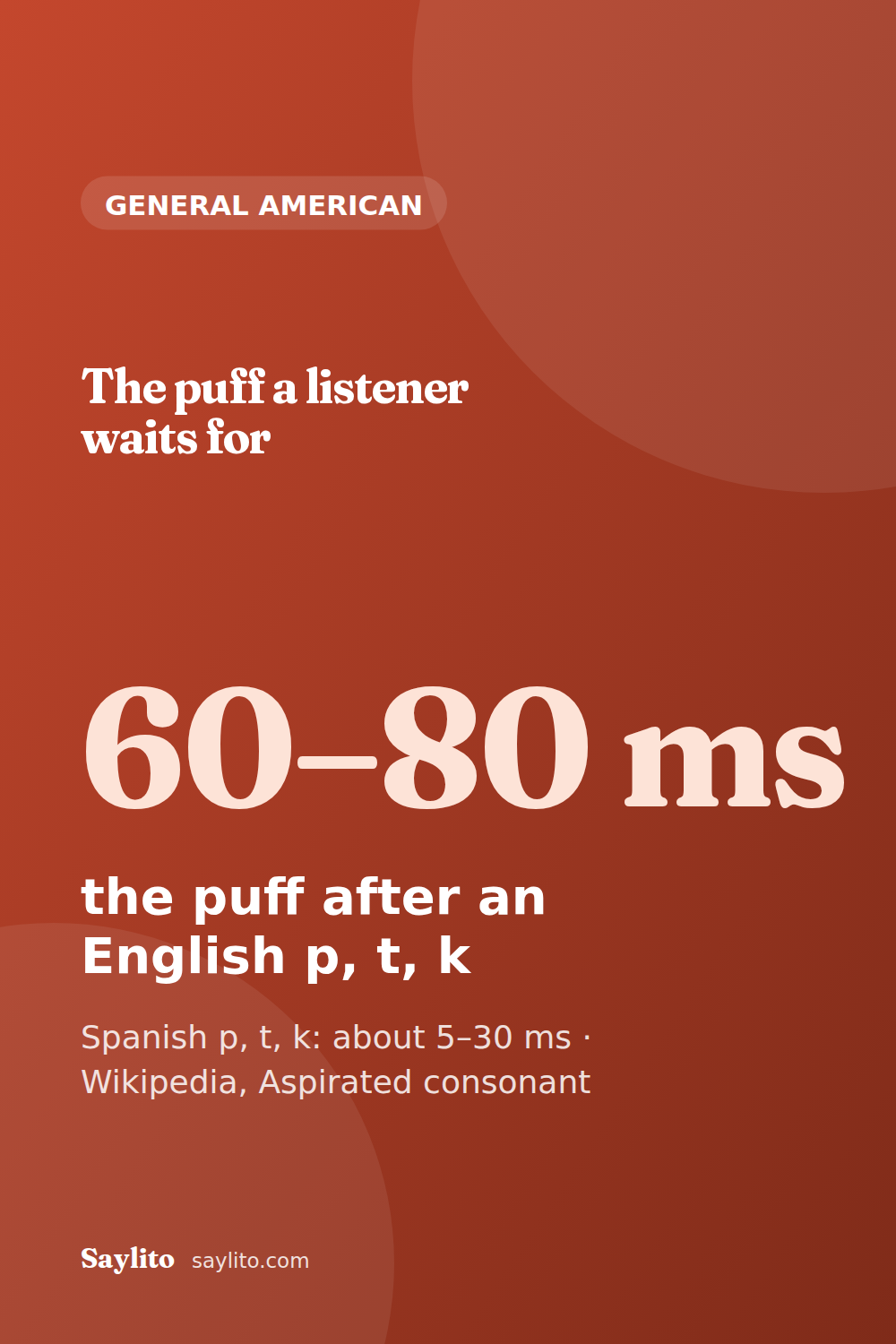
This one is small and easy to miss. In English, p, t and k come out with a short puff of air when they start a word or a stressed syllable. Linguists call it aspiration. Say them without the puff in those spots and other English speakers may hear the matching b, d or g instead. Then pin sounds like bin, time like dime, and coat like goat.
In numbers: the delay between a Spanish p, t or k and the start of the voice is about 5, 10 and 30 milliseconds. For an English aspirated p, t or k it's about 60, 70 and 80 milliseconds. That gap is the puff.
It can take a while to learn. One group of 24 adults who moved to Canada speaking Russian, Ukrainian or Croatian was followed for 10 years. On average their p got easier to understand, mostly early on, but even after 7 years it still wasn't understood every time. Some were clear from the start, and some still weren't years later. So if this sound is one of yours, it's worth targeted practice rather than waiting for it to fix itself.
The quickest check is a sheet of paper in front of your mouth. Say "pin, bin, pin, bin": the paper should move on pin and barely move on bin. Saylito's p and b drill walks through it step by step.
Optional: the American r and the flap t
Now for two features that make English sound very American, but don't decide whether you're understood.
The r after a vowel. General American says the r in car (/kɑːr/), pearl and fort. Most speakers in England drop it, and so do some American accents, like parts of Eastern New England and New York City. General American listeners often notice a dropped r quickly and hear it as regional. Noticed, though, isn't misunderstood. Whole countries of fluent English speakers drop that r and are understood in the US every day. One exception: an r before a vowel, as in right versus light, does change meaning, and that one is worth practising.
The flap t. In words like water and butter, General American turns the t into a quick tap that sounds close to a d, written with a small mark under the t: /ˈwɑː.t̬ɚ/ and /ˈbʌt̬.ɚ/. The rules for it are complex: flapping is required in some words, not allowed in others (like retail) and optional in still others. A clear t won't turn water into another word. It just sounds careful. If the flap comes naturally, use it. If it doesn't, a clean t is fine.
Skip it: sounds Americans don't agree on
Two features show up in almost every General American guide, and Americans themselves split on both.
- Cot and caught. Many Americans say both as /kɑːt/, the same sound. The two vowels are merging in many parts of North America but not everywhere, so plenty of Americans still keep them apart. Say them however comes naturally to you.
- Mary, marry and merry. Many Americans say all three the same way, and many don't. If you say three slightly different vowels, nobody will be confused.
Time spent on these is time not spent on stress, vowel pairs or that puff of air. There's little point drilling the cot and caught difference when many of the Americans you talk to don't make it either.
A ten-minute daily plan for the features that matter
Short and daily beats long and weekly. Here's a ten-minute routine built only from the "worth the work" list:
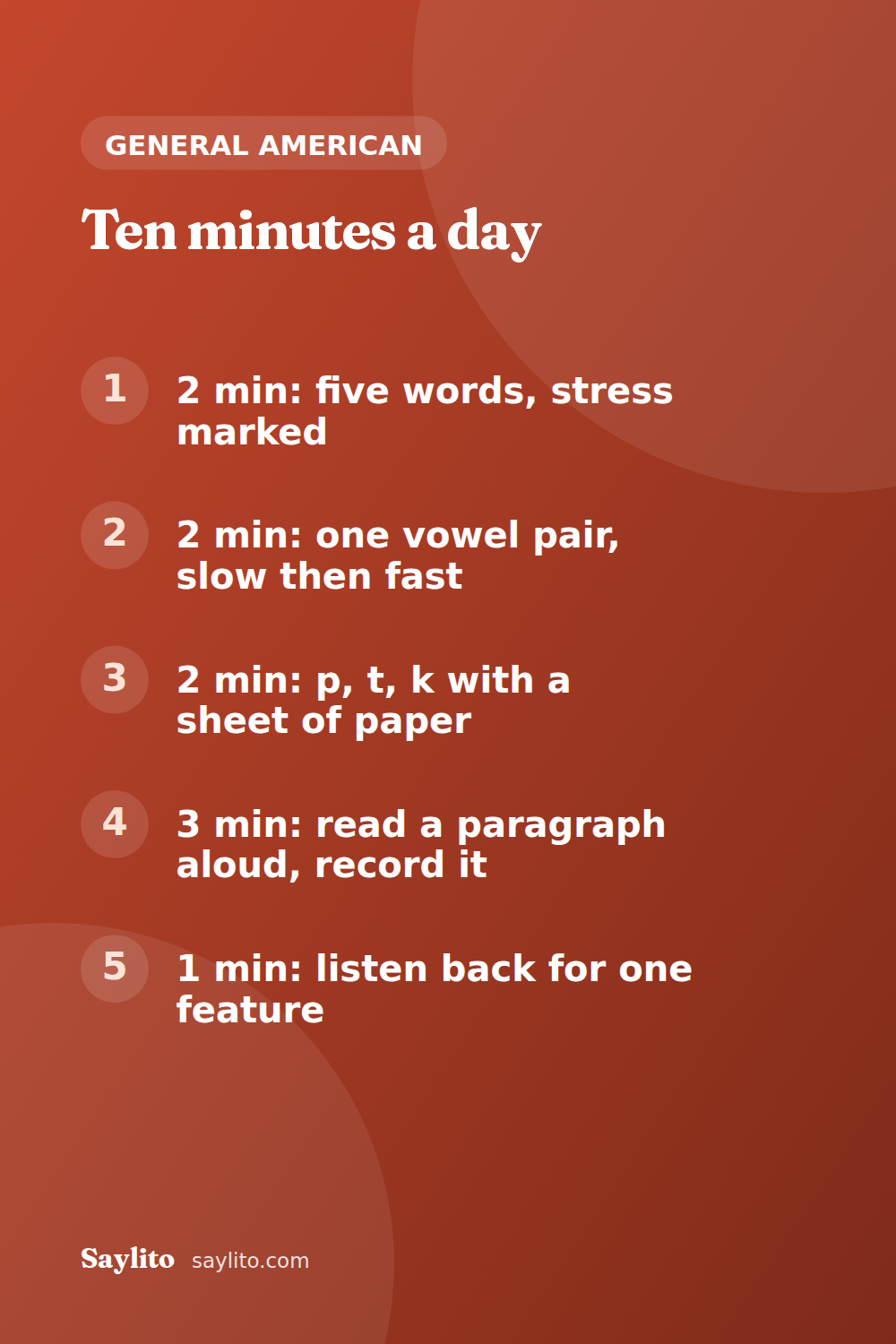
- Two minutes of stress. Pick five words you use at work, look up each one's US entry in a dictionary, and say it with the stressed syllable clearly longer. Then say a sentence with each.
- Two minutes on one vowel pair. Ship and sheep today, full and fool tomorrow. Say each pair slowly five times, then at normal speed.
- Two minutes of p, t and k. Paper in front of your mouth: pin, bin, time, dime, coat, goat. Watch the paper, not the mirror.
- Three minutes of reading aloud. Read a short paragraph from anything you'd read anyway, and record it on your phone.
- One minute of listening back. Listen for one feature only, like the stress in long words. Trying to hear everything at once means hearing nothing.
Not sure which sounds to start with? Saylito's free accent test has you read six short sentences aloud and shows the sounds a listener may miss, so you can practice those first. Its result is practice feedback, measured against American English.
Questions people ask
What is considered a general American accent?
General American is the broad accent of American English that most Americans hear as having no strong regional, ethnic or social flavor. Linguists treat it as a range of accents, not one fixed one. Its best-known features are the r pronounced after vowels (car), the flap t (water), many weak schwa vowels (about) and, for many speakers, cot and caught said the same way.
What do you call a general American accent?
Linguists call it General American, often shortened to GA or GenAm. You'll also see Standard American, and Broadcast English, Network English or Network Standard, because it's tied to the speech of North American radio and TV announcers.
What does a standard American accent sound like?
It keeps the r after vowels in words like car and fort, turns the t in water and butter into a quick tap close to a d, reduces unstressed vowels to a weak uh, and puts a small puff of air on p, t and k at the start of stressed syllables. Americans who speak it still differ on some vowels, like cot and caught.
What's the most generic American accent?
General American is the name for that idea. It isn't tied to one place, but people from the North Midland, Western New England and the Western US, and Americans with more years of education, are the most likely to be heard as speaking it.
Sources
- Wikipedia, General American English: definition, Krapp 1925, other names, rhoticity, flapping, the cot–caught merger, the Mary–marry–merry survey, read 2026-11-08
- Wikipedia, Aspirated consonant: English p, t, k and their timings, read 2026-11-08
- Munro, M. J. and Derwing, T. M. (1995), Processing time, accent, and comprehensibility in the perception of native and foreign-accented speech, Language and Speech 38(3)
- Munro, M. J., Derwing, T. M. and Saito, K. (2025), Aspiring to Aspirate: L2 Acquisition of English Word-Initial /p/ Over 10 Years, Language and Speech 68(2)
- Cambridge Dictionary, US pronunciation of "record" (noun /ˈrek.ɚd/, verb /rɪˈkɔːrd/), read 2026-11-08
- Cambridge Dictionary, US pronunciation of "about" (/əˈbaʊt/), read 2026-11-08
- Cambridge Dictionary, US pronunciation of "ship" (/ʃɪp/) and "sheep" (/ʃiːp/), read 2026-11-08
- Cambridge Dictionary, US pronunciation of "water" (/ˈwɑː.t̬ɚ/) and "butter" (/ˈbʌt̬.ɚ/), read 2026-11-08
- Cambridge Dictionary, US pronunciation of "car" (/kɑːr/), read 2026-11-08
- Cambridge Dictionary, US pronunciation of "cot" and "caught" (both /kɑːt/), read 2026-11-08
Keep reading
Hard Words to Pronounce in English: 27 Everyday Words and Why They Trip You Up
Hard words to pronounce in English that you actually use: 27 everyday words in five groups, why each one is hard, and how Americans say it, in IPA.
How to Pronounce This, These and Those: Three Words, Sound by Sound
How to pronounce this and these in American English: the buzzing th, the short i or long ee, the s or z at the end, plus those and a five-minute drill.
How to Pronounce Through, Though, Thought, Tough and Thorough in American English
How to pronounce through, though and thought in American English, plus tough and thorough: five -ough words, five sounds, and the slips listeners hear.