Words
Hard Words to Pronounce in English: 27 Everyday Words and Why They Trip You Up
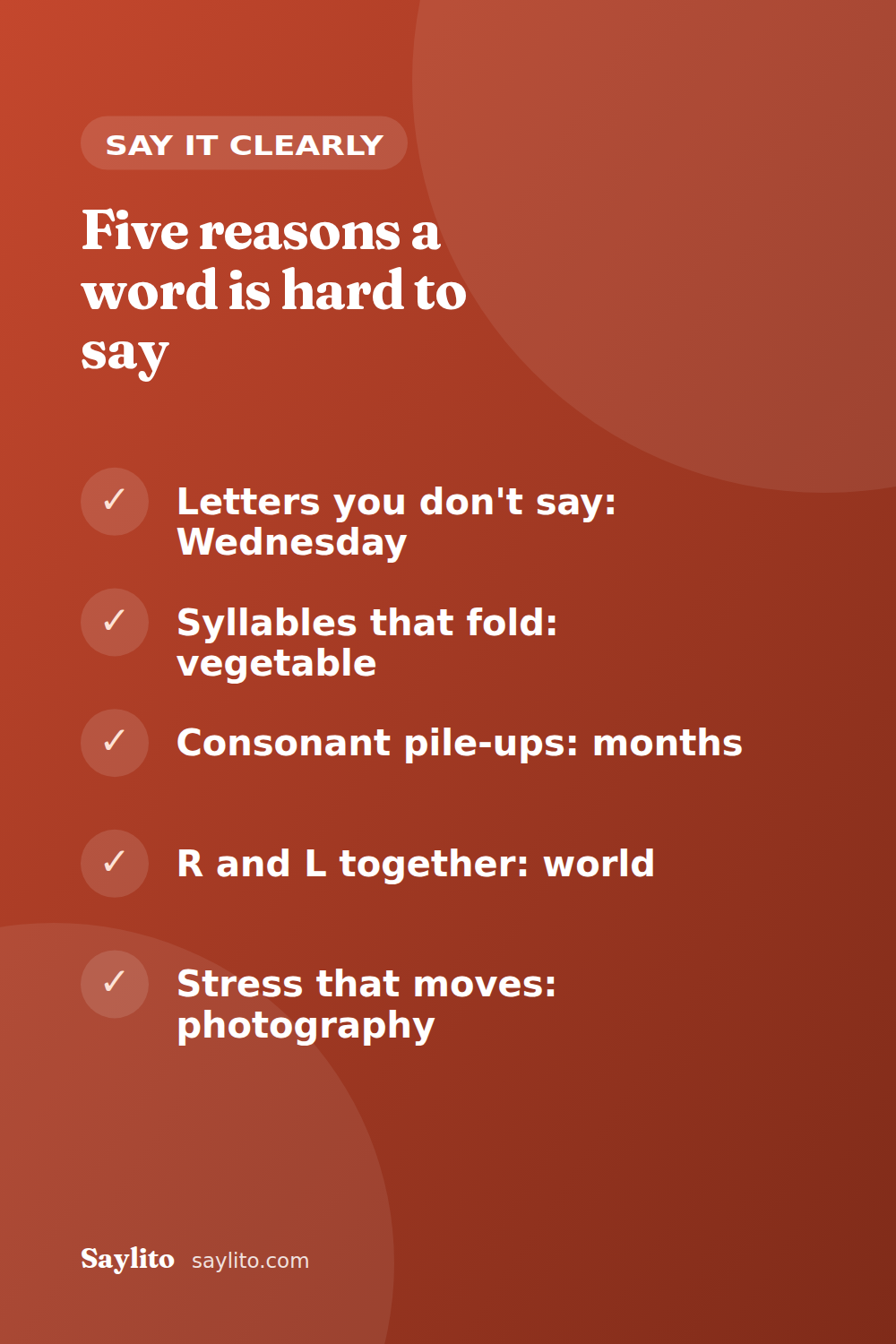
The hard words to pronounce in English aren't the ones on joke lists. Nobody needs “Worcestershire” on a Tuesday. The ones that trip you up are everyday words like Wednesday, vegetable, months, rural and specific, and they're hard for five reasons: letters you don't say, syllables that fold, consonants that pile up, r and l side by side, and stress that moves when the word grows. Learn the reason and you can fix a whole group at once, not one word at a time.
Below are 27 of those words, grouped by what makes them hard, each with its American pronunciation in IPA and a plain respelling you can read aloud. The aim is to be understood easily at work, in shops and on the phone. It isn't about sounding like anyone else.
Hard words to pronounce in English: the short answer
If you only have a minute, here are ten of the 27 that come up most in daily life, with the American way to say them.
| Word | IPA (US) | Say it |
|---|---|---|
| Wednesday | /ˈwenz.deɪ/ | WENZ-day |
| receipt | /rɪˈsiːt/ | rih-SEET |
| vegetable | /ˈvedʒ.tə.bəl/ | VEJ-tuh-bul |
| chocolate | /ˈtʃɑːk.lət/ | CHAHK-lut |
| every | /ˈev.ri/ | EV-ree |
| months | /mʌnθs/ | MUNTHS |
| world | /wɝːld/ | WURLD |
| library | /ˈlaɪ.brer.i/ | LY-brair-ee |
| specific | /spəˈsɪf.ɪk/ | spuh-SIF-ik |
| photography | /fəˈtɑː.ɡrə.fi/ | fuh-TAH-gruh-fee |
The capital letters in the respelling show the stressed syllable: say it a little longer, louder and higher than the rest. Getting the stress right is half the job: the beat is the first thing a listener hears.
Why everyday English words are hard to pronounce
English spelling often records where a word came from or how it was said long ago, not how it's said today. That's why “colonel” has no r in its spelling and an r in its sound, and why “receipt” has a p you never say.
On top of that, everyday speech is fast. The words you say most get worn down the most: syllables fold together, unstressed vowels shrink to a quick “uh”, and clusters of consonants get simplified.
Letters you see but don't say
These words punish careful readers. The more faithfully you say every letter, the harder they are to understand.
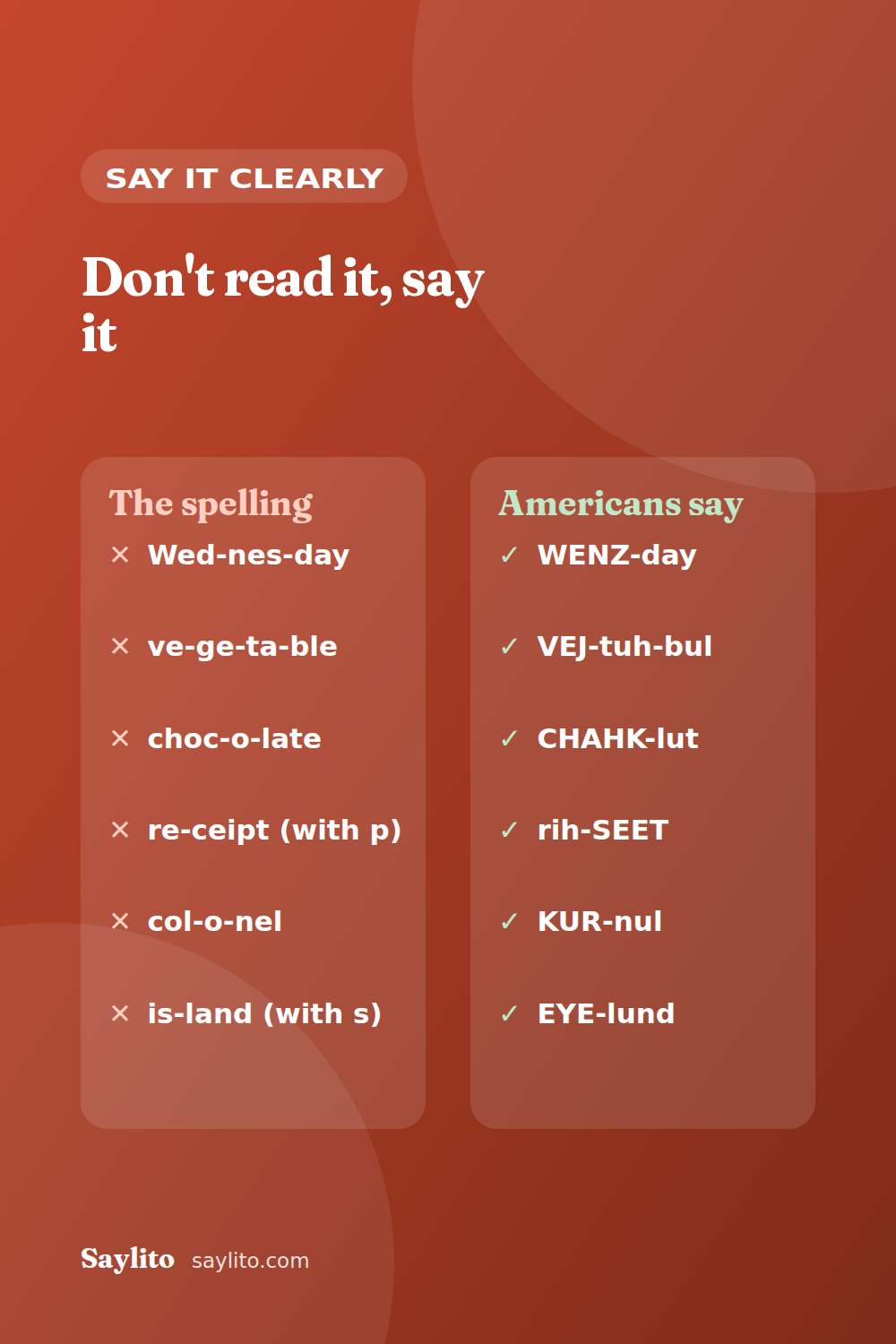
- Wednesday /ˈwenz.deɪ/, WENZ-day. Two syllables. The first d and the middle e are silent. Say “wens”, then “day”.
- receipt /rɪˈsiːt/, rih-SEET. The p is silent. It rhymes with “deceit”.
- island /ˈaɪ.lənd/, EYE-lund. The s is silent, in “island” and in “isle”.
- salmon /ˈsæm.ən/, SAM-un. The l is silent, and the a is the short a of “cat”.
- colonel /ˈkɝː.nəl/, KUR-nul. It sounds exactly like “kernel”. There's no l sound in the first half at all.
- often /ˈɑːf.ən/, AHF-un. The t is usually silent, but some people say it, so you'll hear both.
The trap with this group is the clipped “correct” version. People who say the p in “receipt” are understood, but listeners have to work for it, and at a busy counter that's the moment someone says “sorry?”. Say the word the way it sounds, not the way it's spelled.
Syllables that fold in American speech
Count the syllables on the page and you'll say these words too long. In everyday American English, one vowel drops out and two syllables become one.
- vegetable /ˈvedʒ.tə.bəl/, VEJ-tuh-bul. Three syllables, not four. The e after the g disappears.
- chocolate /ˈtʃɑːk.lət/, CHAHK-lut. Two syllables. The middle o is gone.
- every /ˈev.ri/, EV-ree. Two syllables, and the same goes for “everyone” and “everything”.
- interesting /ˈɪn.trɪ.stɪŋ/, IN-trih-sting. Three syllables, though you'll also hear it with four.
- camera /ˈkæm.rə/, KAM-ruh. Two syllables, and the stress is on the first.
Saying every syllable doesn't make you wrong, and a listener will understand “ve-ge-ta-ble”. But it slows the word down and puts weight where Americans don't, so the whole sentence takes on a different beat. The weak vowel in these words is the schwa, the short, relaxed “uh”, and it's worth a little practice on its own: Saylito's schwa page has it with pairs to drill.
Consonant pile-ups at the end of a word
Many languages don't allow three or four consonants in a row at the end of a word. English does, all the time, and the endings carry grammar: the s of a plural, the t or d of the past. Drop them and a listener may hear a different word or the wrong tense.
- months /mʌnθs/, MUNTHS. An n, a quiet th and an s. If the th is too hard at speed, keep the s: “a few months” still needs to sound plural.
- sixth /sɪksθ/, SIKSTH. Three consonants after the vowel: k, s and th. Slow it down until each one is there, then speed up.
- texts /teksts/, TEKSTS. Four consonant sounds after the vowel: k, s, t, s. Say “text” first, then add a clean s.
- asked /æskt/, ASKT. The -ed is a t here, not “ask-ed”. In fast speech you'll also hear a short form without the k.
- clothes /kloʊðz/, KLOHDHZ. A buzzing th and a z, though it's also said without the th, sounding just like “close”.
The useful lesson in this group: when a cluster is too much, the sound to keep is the one that carries meaning. The s of a plural and the t of a past tense matter more than the th in the middle. Saylito's word endings page drills exactly those endings, and the th page covers the quiet th in “months” and “sixth”.
R and L close together
The American r is made with the tongue pulled back and its tip not touching the roof of your mouth. The l is made with the tip of the tongue on the ridge behind your top teeth. Put them next to each other and your tongue has to travel fast. That's why these short words are much harder than they look.
- world /wɝːld/, WURLD. The vowel is r-colored: start the r sound right away, then touch the tongue tip up for the l, then the d.
- girl /ɡɝːl/, GURL. One syllable. Don't put a vowel between the r and the l.
- rural /ˈrʊr.əl/, ROOR-ul. Two r's and an l in two syllables. Go slowly: ROOR, then a quick “ul”.
- squirrel /ˈskwɝː.əl/, SKWUR-ul. In American English the first syllable is “skwur”, with the r vowel of “word”.
- library /ˈlaɪ.brer.i/, LY-brair-ee. There are two r's. A common slip drops the first one and says “LY-bear-ee”.
- February /ˈfeb.ruː.er.i/, FEB-roo-air-ee. Many Americans drop that first r and say FEB-yoo-air-ee, and either one is understood.
If your first language has one sound where English has r and l, this group is where it shows. A listener uses the rest of the sentence to sort it out, so you'll usually be understood. Still, a minute a day on r against l makes these words much easier, and the r and l page on Saylito has the pairs for it.
Stress that moves when the word grows
In English, adding an ending can move the stress to a different syllable, and every vowel around it changes with it. It's one of the least obvious reasons a word is hard, because you can know a short word perfectly and still trip on its longer cousin.
- photograph /ˈfoʊ.t̬oʊ.ɡræf/, FOH-toh-graf. Stress on the first syllable.
- photography /fəˈtɑː.ɡrə.fi/, fuh-TAH-gruh-fee. The stress jumps to the second syllable, and the first one shrinks to “fuh”. The t in the middle is now a clear t, because it starts the stressed syllable.
- specific /spəˈsɪf.ɪk/, spuh-SIF-ik. Stress on the middle. The first syllable is a quick “spuh”. If the s gets lost, it sounds like “pacific”.
- particularly /pɚˈtɪk.jə.lɚ.li/, per-TIK-yuh-ler-lee. Five syllables, with the main stress on TIK. The rest are short and quick.
- determine /dɪˈtɝː.mɪn/, dih-TUR-min. Stress on the second syllable, and the end is “min”, not “mine”.
When the beat lands on an unexpected syllable, a listener can spend a second searching for the word, even if every sound is right. So get the beat first. With these, say the stressed syllable on its own first, then add the short ones around it: TAH, then fuh-TAH, then fuh-TAH-gruh-fee.
A ten-minute drill for the words you need
Don't try to learn all 27 at once. Pick the five you say most at work or at home, and give them ten minutes a day for a week.
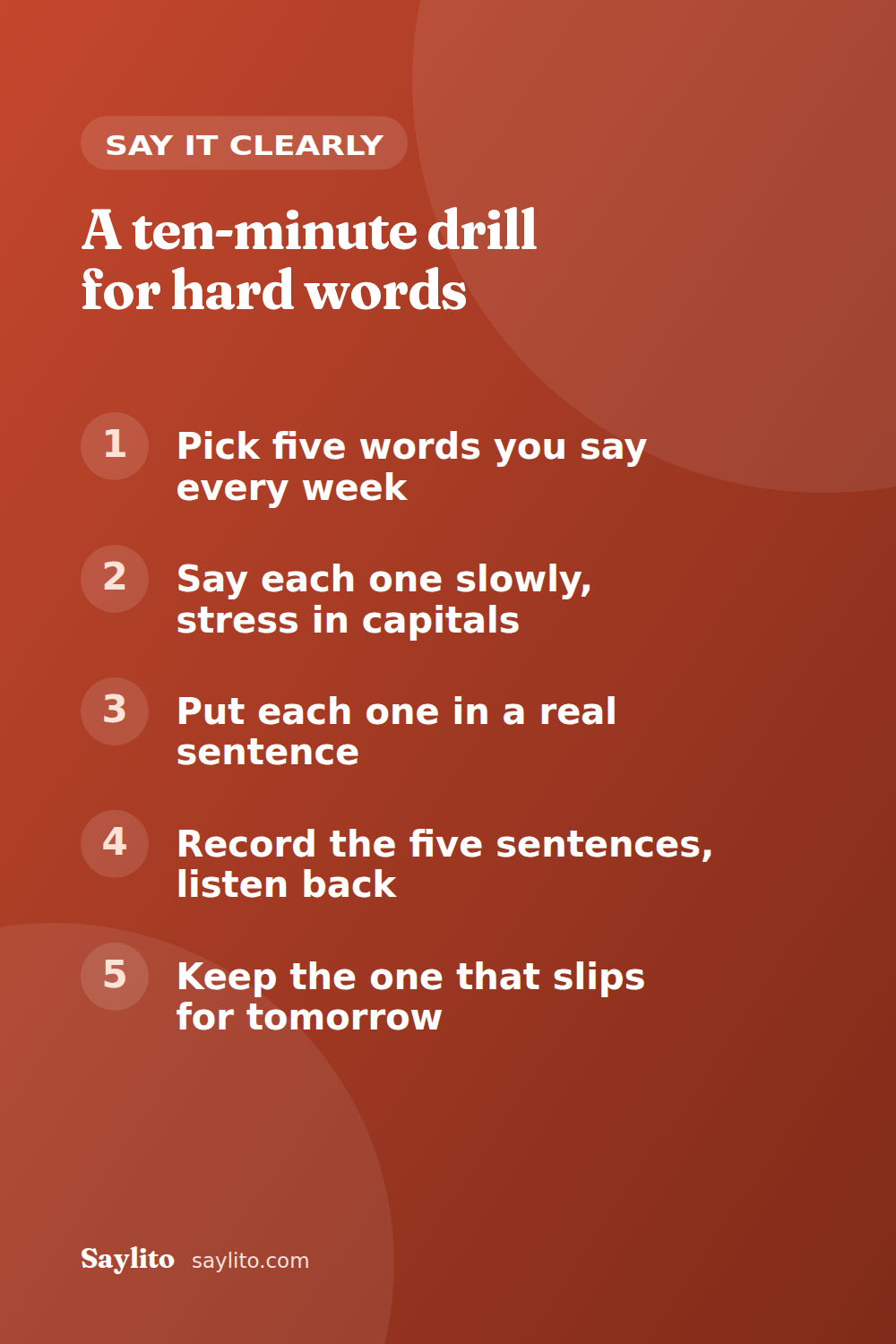
- Pick five words from the list that you actually use: your shift days, the things you buy, the words in your job.
- Say each one slowly, syllable by syllable, leaning on the capital letters in the respelling.
- Put each word in a sentence you'd really say: “Can I get a receipt?” “I'll be off on Wednesday.” “It's been six months.”
- Record the five sentences on your phone and listen back once. Listen for one thing only: the stress, or the ending, or the silent letter.
- Keep the word that still slips and add it to tomorrow's five.
The sentence step matters more than it looks. Words get folded and linked in real speech, so a word you can say perfectly alone can still trip you up between two others. Practise it where it lives.
If you're not sure which sounds to start with, Saylito's free accent test listens to a few sentences you read aloud and shows which sounds to practise first. It's practice feedback, not a grade. And for a voice or speech problem, see a speech-language pathologist.
Questions people ask
What are the 10 hardest words to pronounce in English?
Lists online disagree, and many fill up with rare words like “Worcestershire”. For everyday speech, ten that trip up many learners are Wednesday (WENZ-day), receipt (rih-SEET), vegetable (VEJ-tuh-bul), chocolate (CHAHK-lut), every (EV-ree), months (MUNTHS), world (WURLD), library (LY-brair-ee), specific (spuh-SIF-ik) and photography (fuh-TAH-gruh-fee). They're hard because of silent letters, folded syllables, consonant clusters, r and l together, and moving stress.
Sources
- Cambridge Dictionary, US pronunciation of “Wednesday” (/ˈwenz.deɪ/), read 2026-11-07
- Cambridge Dictionary, US pronunciation of “receipt” (/rɪˈsiːt/), read 2026-11-07
- Cambridge Dictionary, US pronunciation of “colonel” (/ˈkɝː.nəl/), read 2026-11-07
- Cambridge Dictionary, US pronunciation of “often” (/ˈɑːf.ən/ and /ˈɑːf.tən/), read 2026-11-21
- Cambridge Dictionary, US pronunciation of “vegetable” (/ˈvedʒ.tə.bəl/), read 2026-11-07
- Cambridge Dictionary, US pronunciation of “interesting” (/ˈɪn.trɪ.stɪŋ/), read 2026-11-07
- Cambridge Dictionary, US pronunciation of “clothes” (/kloʊðz/), read 2026-11-07
- Cambridge Dictionary, US pronunciation of “library” (/ˈlaɪ.brer.i/), read 2026-11-07
- Cambridge Dictionary, US pronunciation of “February” (/ˈfeb.ruː.er.i/), read 2026-11-07
- Cambridge Dictionary, US pronunciation of “photograph” (/ˈfoʊ.t̬oʊ.ɡræf/), read 2026-11-07
- Cambridge Dictionary, US pronunciation of “photography” (/fəˈtɑː.ɡrə.fi/), read 2026-11-07
- Cambridge Dictionary, US pronunciation of “particularly” (/pɚˈtɪk.jə.lɚ.li/), read 2026-11-07
- Carnegie Mellon University, The CMU Pronouncing Dictionary (cmudict): entries for often, interesting, texts, asked, clothes, months and February, read 2026-11-07
Keep reading
How to Pronounce Through, Though, Thought, Tough and Thorough in American English
How to pronounce through, though and thought in American English, plus tough and thorough: five -ough words, five sounds, and the slips listeners hear.
How to Pronounce This, These and Those: Three Words, Sound by Sound
How to pronounce this and these in American English: the buzzing th, the short i or long ee, the s or z at the end, plus those and a five-minute drill.
Words Americans Pronounce Differently: 32 Everyday Words, US vs UK, by Pattern
Words Americans pronounce differently from British English, sorted by the pattern behind them: 32 everyday words with UK and US IPA side by side.