Accents
Is the R Silent in Library? February, Surprise, Fork and More in American English

No. In American English the r in library isn't silent, and neither is the r in fork, car, bird or forward. The standard American accent keeps the r wherever it's written, and the only place a speaker sometimes skips one is a word with two r's close together, like library, February and surprise. So if you say every r, you're saying these words the standard way, and any listener will understand you. Here's where the r stays, where it sometimes goes, and how to say the tricky words one beat at a time.
Is the R silent in library? The short answer
- Not in American English. The r is said in library, fork, car, bird and forward.
- Much of Britain is different. Many British accents drop the r after a vowel, so fork and car have no r sound at all.
- Two r's close together are the exception. In library, February, surprise, particular and governor, some Americans leave one r out.
- Iron and turmeric keep their r's. They are said EYE-urn and TUR-mer-ik.
- Your safest move is to say every r. The full version is right in every one of these words.
Learners ask this question because the spelling and the sound seem to disagree. They mostly don't. English spelling keeps every r, and American speech says nearly all of them.
Is the R silent in fork, car and bird? Why American English keeps it
In standard American English the r after a vowel is always said, so fork, car and bird each have a clear r. Linguists call this a rhotic accent. In a rhotic accent the r survives in every position. In a non-rhotic accent it disappears after a vowel, unless another vowel comes right after it. The United States, Canada, Scotland and Ireland are mostly rhotic. Most of England, Wales, Australia, New Zealand and South Africa are not.
That's why the same word can look silent in one recording and loud in the next. Here's what the difference looks like in five common words.
| Word | American English | Many British accents |
|---|---|---|
| fork | /fɔːrk/ | /fɔːk/ |
| car | /kɑːr/ | /kɑː/ |
| bird | /bɝːd/ | /bɜːd/ |
| forward | /ˈfɔːr.wɚd/ | /ˈfɔː.wəd/ |
| iron | /aɪrn/ | /aɪən/ |
Look at bird. The American vowel in it is one sound with the r built in, so there's no separate r to hunt for: the vowel itself has an r color. The same thing happens at the end of dollar, butter and color, and in the middle of third and nurse. These are called r-colored vowels, and they're a big part of why American English sounds the way it does.
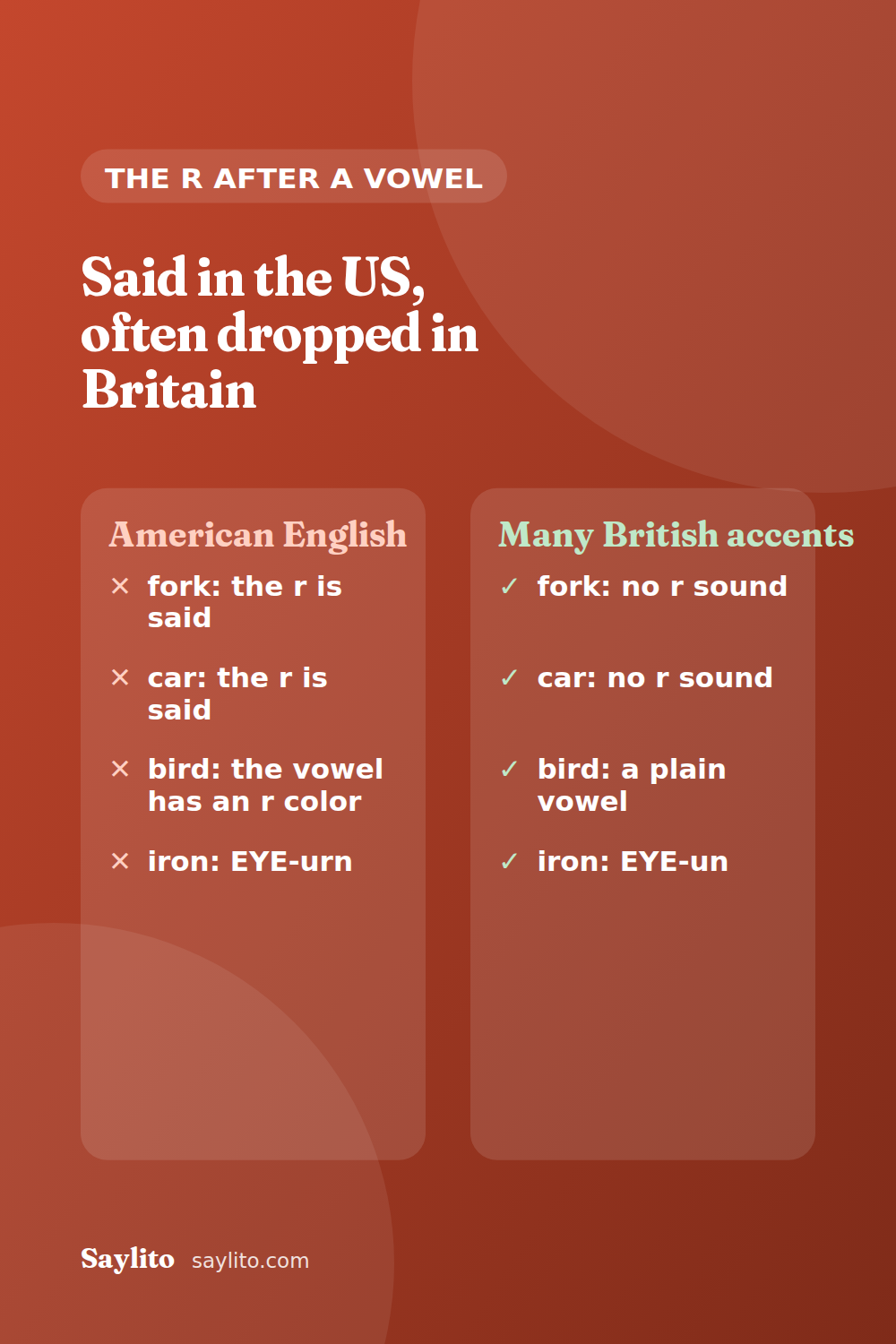
Not every American keeps the r everywhere. In some parts of the northeastern coast and the South, an r after a vowel comes and goes depending on the speaker and the situation. On national TV, radio and film, though, the r has been firmly there since the middle of the 20th century, and it's one of the features of the General American accent.
If the American r itself is hard to make, the free r and l sound page shows the tongue and lip steps and has a short drill. This post is about where the r goes, and the next part is about the places it seems to go missing.
Library, February and surprise: the r that some speakers skip
When two r's sit close together in the middle of a word, one of them often fades in everyday speech, and it's usually the weaker one. That's why surprise turns into suh-PRIZE, particular into puh-TIK-yuh-ler and governor into GUV-uh-ner. Government keeps its r, because it has only one.
| Word | Both r's said | One r skipped |
|---|---|---|
| surprise | sur-PRIZE | suh-PRIZE |
| particular | per-TIK-yuh-ler | puh-TIK-yuh-ler |
| governor | GUV-er-ner | GUV-uh-ner |
| February | FEB-roo-air-ee | FEB-yoo-air-ee |
Library has the same setup: one r early, in the br, and another near the end. The standard American pronunciation keeps both, LY-brair-ee. Some speakers drop the first one, so you may hear LY-berry too, and that's why so many people wonder whether the r is silent. It isn't. It's just easy to skip when the word is said fast.

February is the odd one, because the first r doesn't simply vanish. It turns into a y sound, which gives FEB-yoo-air-ee. One explanation is that people copy the ending of January, YOO-air-ee. Either way, the last r, in AIR, stays in both versions.
Iron, turmeric and forward: the r you do say
Iron fools more learners than any of these, because the r sits between the o and the n in the spelling and it's easy to say EYE-on. In American English the vowel runs straight into the r: EYE-urn. It's closer to one stretched syllable than to two, and it ends in a clear r and then n. The British EYE-un is the version with no r.
Turmeric has two r's and the standard American pronunciation keeps both, TUR-mer-ik. The first is part of the vowel in TUR, and the second sits between two vowels in mer.
In forward, the r comes before a w: FOR-werd. Say the r, then let your lips round straight into the w with no gap between them. The r is there in American English even though a consonant follows it.
The r at the end of words: butter, dinner and color
An r at the end of a word can feel like an extra letter you could leave off. In American English it isn't extra. The -er ending in butter, dinner, color and dollar is one short vowel with r color, and the r is part of that sound, not a separate beat after the t or the n.
The stressed version is the vowel in third, nurse and hearse. The unstressed version is the ending of standard, dinner and butter. They're the same family of sound, and both keep the r. If you can say bird, you already have the stressed one.
Here's a quick test for any word that ends in -er, -ar or -or. Say it, then say it again and keep your tongue pulled back for the whole ending. If your tongue stays flat at the end, the r went quiet. Try it on start and car, which have an r-colored a, and on north and war, which have an r-colored o.
How to say library, February and surprise, sound by sound
Start slowly and keep the r light. The American r never touches the roof of your mouth. Your tongue pulls back and up, your lips round a little, and the sound glides into the next vowel. Then take each word in beats.
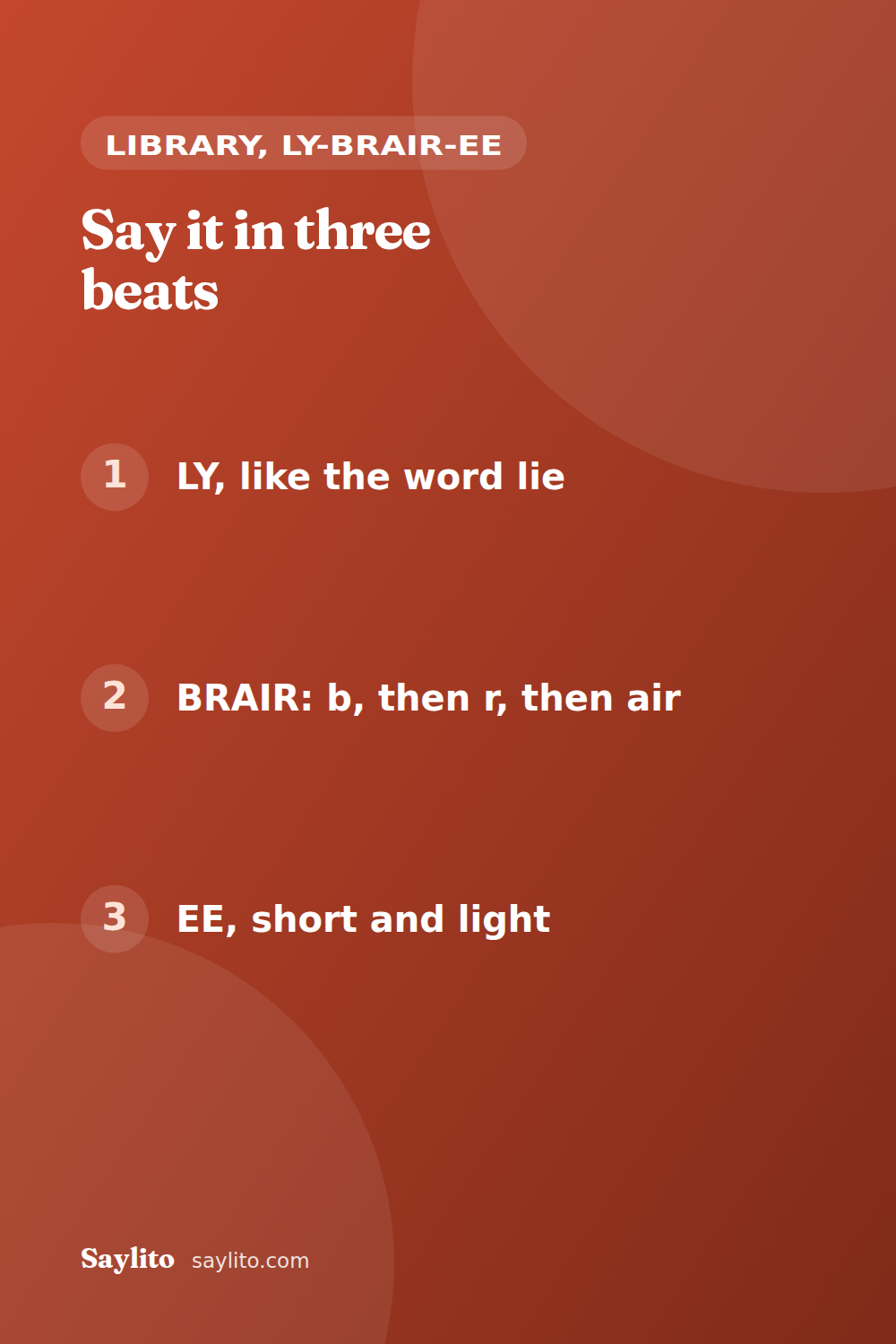
- Library, LY-brair-ee. Say LY, then BRAIR, then EE. Put the r right after the b, and finish BRAIR with your tongue still pulled back before the light EE.
- February, FEB-roo-air-ee. Four beats: FEB, ROO, AIR, EE. Stress the first beat. If you like FEB-yoo-air-ee better, swap ROO for YOO and keep the AIR.
- Surprise, sur-PRIZE. The stress is on the second beat. Say sur lightly, then PRIZE, with the r right after the p.
- Iron, EYE-urn. Glide from the eye sound straight into the r, then close with n. No o sound in the middle.
Which pronunciation should you use?
Use the full version. It matches the spelling, every listener understands it, and you never have to wonder whether you've dropped the right r. You'll hear the shortcuts around you anyway, so it helps to recognize them, and nothing is wrong with using them once you're comfortable. What decides whether you're understood isn't the middle r of surprise. It's the sounds that change a word, like the r and l in “right” and “light”.
If you want more words like these, hard words to pronounce in English covers 27 everyday words and what trips people up in each one.
A five-minute drill for the r in the middle of words
- Read these five words slowly: library, February, surprise, iron, turmeric.
- Say each one twice, with every r said.
- Say this sentence slowly, then at normal speed: “The library has a surprise sale in February.”
- Say this one the same way: “I put the iron and the turmeric in the car.”
- Record both sentences and listen for each r in turn. Say them again where one went missing.
Do it once a day for a week and the r in these words will feel like part of the word, not an extra step. If you'd like to hear how your own r sounds, Saylito's free accent test listens to a few sentences and shows which sounds to practice first. For a voice or speech problem, see a speech-language pathologist.
Questions people ask about the silent r
Can the letter R be silent?
In some accents, yes. In most of England, Wales, Australia, New Zealand and South Africa, an r after a vowel isn't pronounced unless another vowel follows it. In American English the r is said in nearly every place it's written.
What is the correct way to pronounce library?
In American English it's LY-brair-ee, with both r's. Some speakers drop the first r and say LY-berry in fast speech, but the full version is the one that matches the spelling.
Why did the British stop pronouncing R?
Losing the r after a vowel began in southeastern England in the 15th century and spread slowly. By the early 19th century the standard southern British accent had dropped it. A few American port cities with close ties to Britain dropped it in the 18th century too, but most of the country kept it.
Is the R silent in fork?
Not in American English. Fork has a clear r, /fɔːrk/. In many British accents fork has no r sound.
Sources
- Cambridge Dictionary: library (US and UK pronunciations; read 2026-11-22)
- Cambridge Dictionary: February (read 2026-11-22)
- Cambridge Dictionary: surprise (read 2026-11-22)
- Cambridge Dictionary: particular (read 2026-11-22)
- Cambridge Dictionary: governor (read 2026-11-22)
- Cambridge Dictionary: iron (read 2026-11-22)
- Cambridge Dictionary: turmeric (read 2026-11-22)
- Cambridge Dictionary: forward, fork, car and bird (read 2026-11-22)
- Wikipedia: Rhoticity in English (read 2026-11-22)
- Wikipedia: Dissimilation (phonology) (read 2026-11-22)
- Wikipedia: R-colored vowel (read 2026-11-22)
Keep reading
General American Accent: The Features That Help You Be Understood
The General American accent, explained for learners: what it is, which of its sounds help listeners understand you, and which ones you can safely skip.
Hard Words to Pronounce in English: 27 Everyday Words and Why They Trip You Up
Hard words to pronounce in English that you actually use: 27 everyday words in five groups, why each one is hard, and how Americans say it, in IPA.
Words Americans Pronounce Differently: 32 Everyday Words, US vs UK, by Pattern
Words Americans pronounce differently from British English, sorted by the pattern behind them: 32 everyday words with UK and US IPA side by side.