Accents
American Accent vs Canadian Accent: What Actually Differs for an English Learner

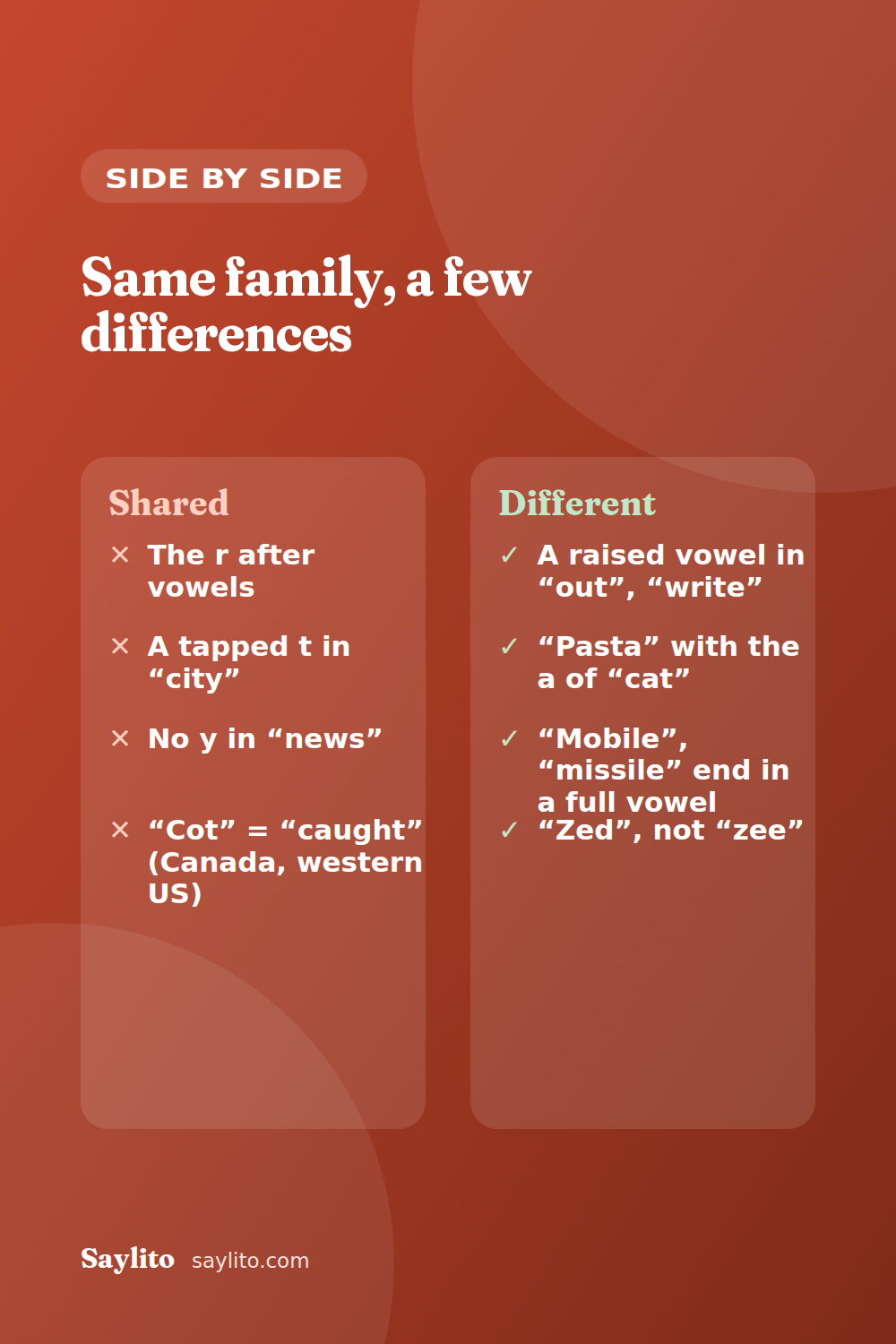
The American accent and the Canadian accent are close cousins, and for a learner the differences are small details, not a second language to study. Most English-speaking Canadians speak a kind of North American English that is most similar to the English of the western United States and to General American. They share the r after vowels, the quick tapped t in “city” and the missing y in “news”. They split on a handful of vowels, a few words and some everyday vocabulary. If you aim at General American, you are aiming very near what most Canadians speak.
American accent vs Canadian accent: the short answer
- They are very close. The grammar and most of the sound system are the same family.
- The famous difference is a vowel. In words like “out”, “house” and “about”, Canadians start the vowel a little higher in the mouth. This is called Canadian raising.
- A few word groups differ. “Pasta”, “mobile”, “missile” and “shone” are said differently in Canada and the US.
- Some everyday words differ. “Tap” and “faucet”, “washroom” and “restroom”, “zed” and “zee”.
- Neither one is the wrong one. Pick the model your listeners use, and practice the sounds that change meaning first.
Is the Canadian accent similar to the American accent? What they share
More than they differ. In grammar and in the most systematic parts of its pronunciation, the English of most Canadians, from British Columbia to Nova Scotia, is a type of North American English. Four shared patterns are the ones a learner meets every day.
- The r is pronounced after vowels. “Start” and “north” keep their r in both countries.
- A t between vowels turns into a quick tap. “City”, “better” and “party” sound like “siddy”, “bedder” and “pardy” on both sides of the border.
- No y in “new”. “News”, “student” and “Tuesday” are said “nooze”, “stoodent” and “toozeday”, though some Canadians prefer the British “nyooze”.
- “Cot” and “caught” sound the same. In Canada and in the western United States, “cot” and “caught”, “stock” and “stalk”, “don” and “dawn” are homophones. In parts of the eastern US they are not.
That last pattern matters if you are learning General American. In the western United States those pairs sound the same too, so there is one contrast fewer to worry about, and it happens to match what you hear in a lot of Canadian speech.
Do Canadians say “oot and aboot”? Canadian raising, explained
No, not the way the joke goes. The stereotype exaggerates a real pattern. What actually happens is a shortening of the two-part vowels in words like “price” and “mouth”. The vowel begins a little higher in the mouth than it does in other accents, so “out” does not turn into “oot”. It turns into a vowel that sits slightly higher than the American one.
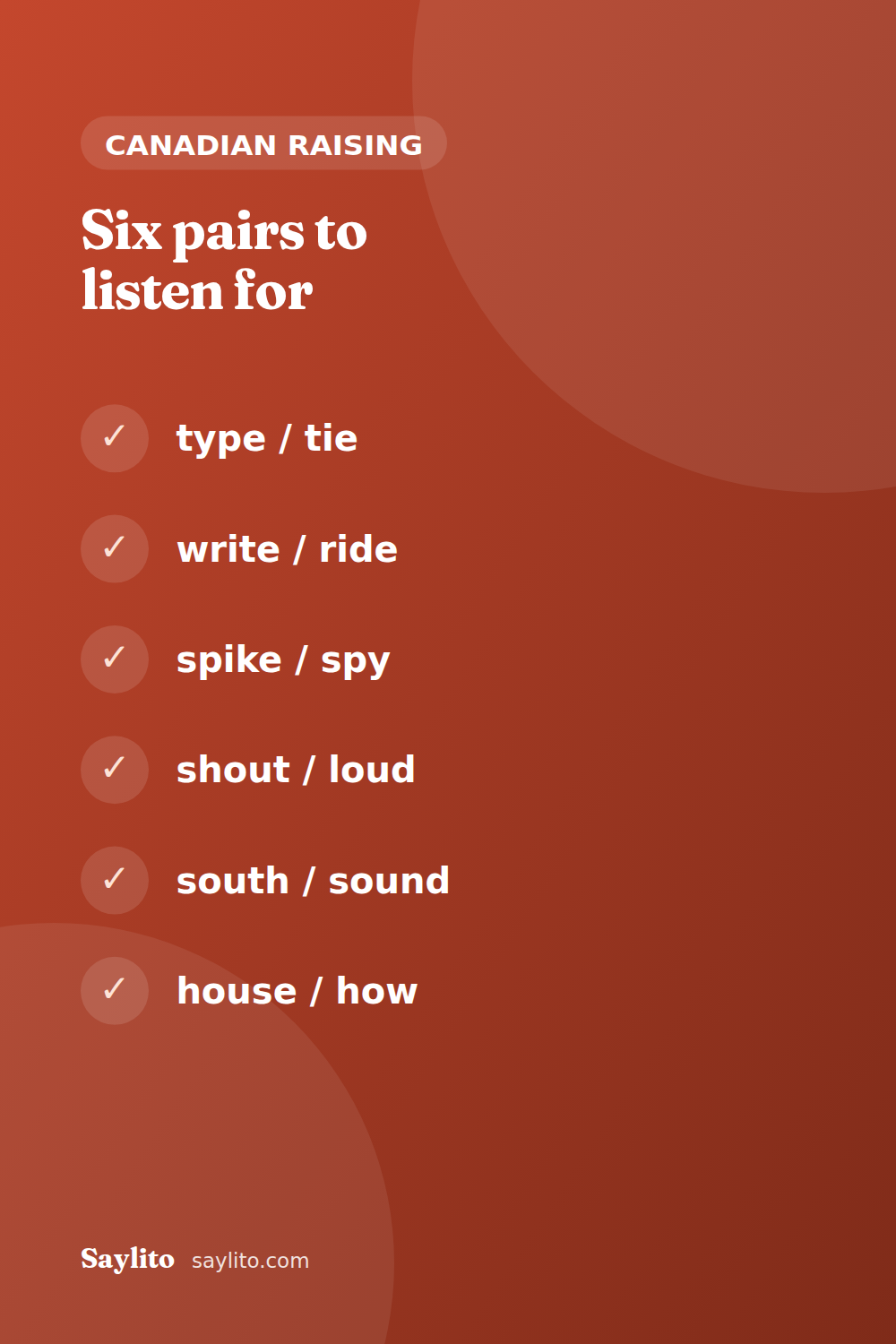
The pattern only happens before the voiceless consonants p, t, k, f, th and s. That is why a Canadian ear can tell the pairs apart where an American ear hears the same vowel: “type” against “tie”, “write” against “ride”, “spike” against “spy”, “shout” against “loud”, “south” against “sound” and “house” against “how”. In each pair, the first word has the raised vowel and the second word does not. Some American accents also raise the vowel in the “price” words, but raising in the “mouth” words is the more distinctly Canadian habit.
The American way to say these is the one American dictionaries give. “About” is /əˈbaʊt/, with a vowel that starts low in the mouth and glides up, and “house” follows the same pattern. If you say them that way, you are saying them like most Americans. Hearing the Canadian version is a good listening exercise, but nothing obliges you to copy it.
How to tell an American from a Canadian: five word groups
There is no single sign, and plenty of Americans and Canadians sound like each other. Still, a few word groups often give it away, and they show up in the learner's everyday vocabulary.
| Word group | Common American way | Common Canadian way |
|---|---|---|
| out, house, about, write | A vowel that starts low and glides up | A vowel that starts a little higher (Canadian raising) |
| pasta, avocado, kebab, mantra | The “ah” of “palm” in every one | The a of “cat” in all of them; younger Canadians use the American “ah” in some words, like taco, macho and mafia |
| mobile, missile, hostile, fertile | A weak ending: “mobile” rhymes with “noble” | A full vowel ending, like the end of “profile” |
| shone (past of shine) | Rhymes with “bone” | Rhymes with “gone”, as in Britain |
| process, project, progress | An “ah” in the first syllable | Some Canadians say “oh”, as in “go”; not every Canadian does |
Treat the table as habits, not rules. American dictionaries show how much room there is inside one country: “mobile” is listed as /ˈmoʊbəl/ first, with other endings as variants, and “pasta” is listed as /ˈpɑstə/ with the short a of “cat” as a second option. You will meet Americans and Canadians who do the opposite of the table.
Do Canadians say “eh”? The word everyone talks about
Some do, and the word has a real job: it asks a listener to confirm that they have understood or agree, as in “The game starts in half an hour, eh?”. You will hear it in Canada, though much less often from younger speakers.
As a learner, you don't need “eh”. A listener in either country understands “right?” or “okay?” just as well, and it is easy to overdo a word that you picked up from television.
The words that change too: zed, tap, washroom and toque
Accent is only part of what differs. If you move between the two countries, vocabulary will surprise you more often than vowels. In general, Canadians follow the American model on everyday words like apartment, elevator, flashlight, fries, pants, sweater and truck. A short list goes the other way, and a few words are Canadian alone.
| Meaning | Usual Canadian word | Usual American word |
|---|---|---|
| The last letter of the alphabet | zed | zee |
| What controls the water in a sink | tap | faucet |
| The tally of charges at a restaurant | bill | check |
| Knives, forks and spoons | cutlery | silverware |
| The sweet topping on a cake | icing | frosting |
| A public toilet | washroom | restroom |
| A tight-fitting wool winter hat | toque | beanie |
| A machine that gives you cash | bank machine | ATM |
Spelling is a mix, too. Canadians tend to use British forms like “colour”, “centre”, “cheque”, “grey” and “travelled”, with exceptions, and the choice varies by word and publication. If you are writing for school or work in Canada, follow the style guide you are given.
Which accent should you learn?
The one your listeners use. If you live and work in Canada, the people around you are your best model. If you are learning for the United States, or you want a standard that is easy to find in dictionaries, recordings and lessons, General American is a sensible choice and the one Saylito's practice is built around. Either way, you are not choosing between two languages.
Whichever you choose, put the time where it pays off. The vowel pairs that change a word, like “ship” and “sheep”, word stress, and the schwa matter more for being understood than whether you raise the vowel in “house”. Our guide to the General American accent shows the features worth the work and the ones you can skip. A word here and there in the other accent is no problem. Mixing is fine in daily talk; it only helps to know which one you are using when you practice.
A five-minute listening drill
You can train your ear to catch the difference without changing how you speak. Pick a few minutes of Canadian speech, like a radio newscast, and a few minutes of American speech, such as a podcast.
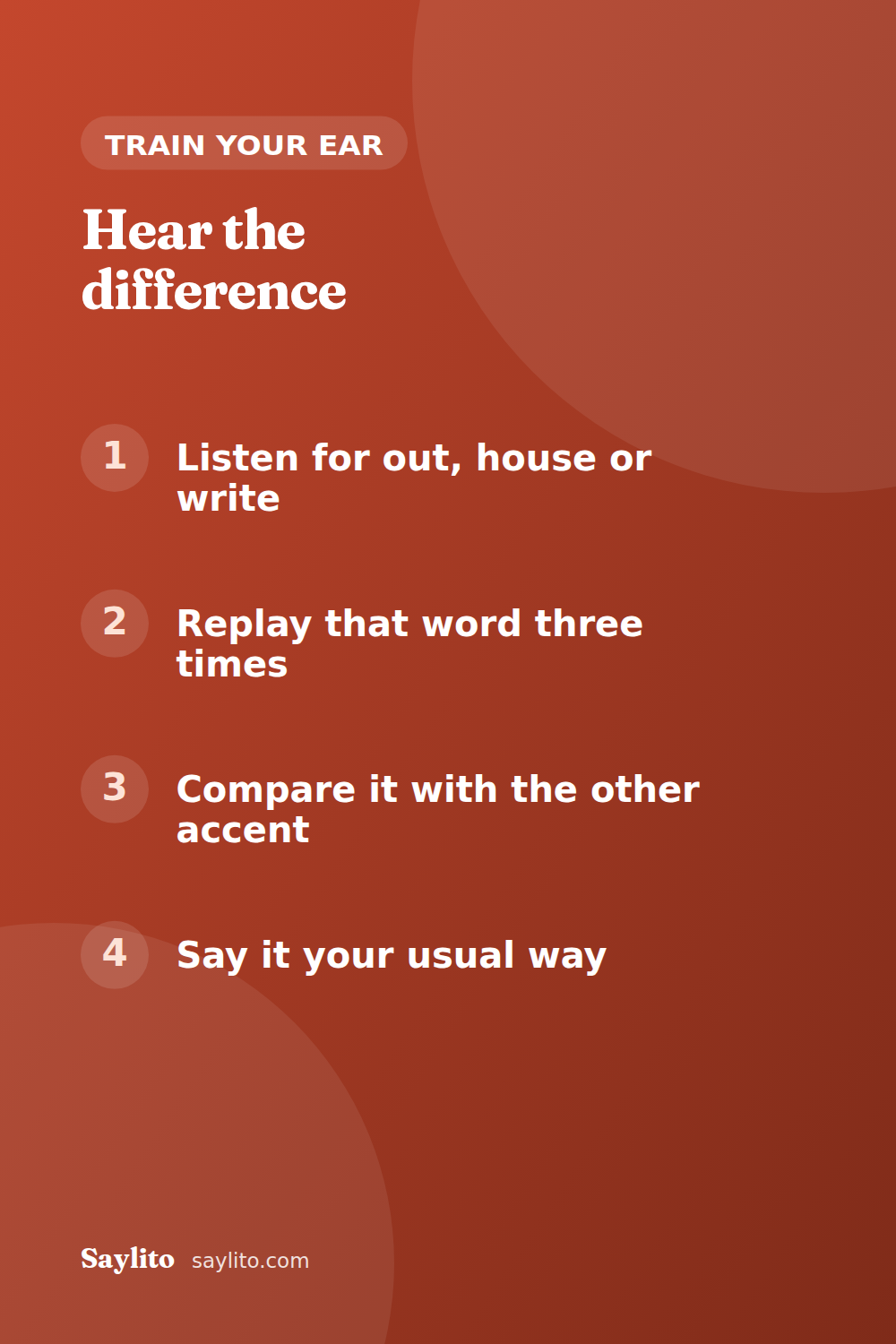

- Listen for a word from the list above, such as “out”, “house” or “write”.
- Replay that one word three times and notice how the vowel starts.
- Find the same word in a recording of the other accent and compare.
- Say the word your own way, then move on. You are training your ear, not changing your voice.
If you would like to hear how your own sounds are coming along, Saylito's free accent test listens to a few sentences and shows which sounds to practice first. For a voice or speech problem, see a speech-language pathologist.
Questions people ask about American and Canadian accents
Is the Canadian accent similar to the American accent?
Very. The English of most Canadians is a type of North American English, closest to the western United States and General American, in its grammar and in the most systematic parts of its pronunciation. They share the r after vowels, the tapped t in “city” and the missing y in “news”.
How to tell an American from a Canadian?
There is no single sign. Common clues are the raised vowel in “out”, “house” and “write”, the a of “cat” in “pasta”, a full vowel at the end of “mobile” and “missile”, “shone” rhyming with “gone”, and words like “zed”, “tap” and “washroom”. Many speakers use none of them.
Do Canadians say “aye” or “eh”?
Some Canadians say “eh” to ask a listener to agree or confirm something, and you will hear it in Canada, though much less often from younger speakers. Canadians do not say “oot and aboot”: the real pattern is a vowel that starts slightly higher in the mouth.
Sources
Keep reading
General American Accent: The Features That Help You Be Understood
The General American accent, explained for learners: what it is, which of its sounds help listeners understand you, and which ones you can safely skip.
Words Americans Pronounce Differently: 32 Everyday Words, US vs UK, by Pattern
Words Americans pronounce differently from British English, sorted by the pattern behind them: 32 everyday words with UK and US IPA side by side.
How to Pronounce Through, Though, Thought, Tough and Thorough in American English
How to pronounce through, though and thought in American English, plus tough and thorough: five -ough words, five sounds, and the slips listeners hear.